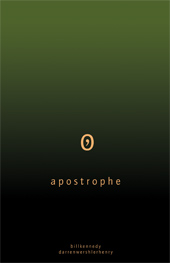
Digital Literature has just taken the long anticipated “great leap forward” with the appearance of the beta version (and book) of Bill Kennedy and Darren Wershler-Henry’s “The Apostrophe Engine.” A simple idea that makes a lot of funky.

cover_170.jpg

new_cat_high_contrast.jpg

“Kluge: A Meditation and other works,” my MFA thesis, is now online. It has a whole bunch of new shorter electronic poems, a pdf of new writing (poetry, essays, etc.) and the One Letter At a A Time Series among other fun things. Check it out. The poem “Kluge” is still in development — I’m training it to write poems based on the source text, and adding other fun gizmos, but the first version is still pretty fun to read.

Kluge: A Meditation and other works

My web poem Kluge which I’ve been developing as my thesis project here at Brown is now writing poems based on the text. Here are a few examples (click to enlarge):

poem_1.jpg

poem_2.jpg

poem_3.jpg

PRESS RELEASE 
April 2006

e-motive: Visual Poetry in the Digital Age

15th June – 6th July

Private view: Friday 16th June

The University Gallery
University of Essex
Wivenhoe Park
Colchester  CO4 3SQ

Opening hours:
Monday to Friday 11am – 5pm, Saturdays 1 – 4.30pm

Admissions: Free

Visual Poetry Exhibition

e-motive is a group exhibition showcasing a variety of computer-generated visual poems by international artists based in Argentina, Brazil, Canada, the United Kingdom and the United States.

The featured works have been created through computer software, allowing for experimentation in digital imaging, animation, electronic sound and holography. The aural, visual, animated and interactive qualities of these exhibits give an insight into a medium of poetry in which electronics push visual poetry’s boundaries.

This exhibition will explore works, where both written language and visual elements are juxtaposed to function in creative tension. In each piece language is treated as raw material, yet enriched by the dynamic nature and physical possibilities of technology.

The selected artworks will range from prints and projections to those displayed on computer monitors, all of which will be set in a dimly lit space, immersing the viewer in a theatrical experience. 

In short, e-motive aims to reveal the latest practices in visual poetry. It will challenge the viewer’s perceptions of poetry, as words are no longer static but set free on the page/screen, demanding the viewer to think anew.

Artists include: Jim Andrews, Giselle Beiguelman, Ladislao Pablo Gyori, Eduardo Kac, Robert Kendall, María Mencía, Ana María Uribe, Brian Kim Stefans and Nico Vassilakis.

Curated by MA Gallery Studies Students: Laura Carnicero, Lydia Gordon, Eleftheria Leventaki and Caroline Sones.

An illustrated catalogue published by Palladian Press will accompany the exhibition.

For further information and images please contact Lydia Gordon (07818421165) or Caroline Sones (07958902062)

E-mail: vp2006@essex.ac.uk                                          
Fax: 01277 220145

I know this blog can seem at times as little more than a testament to my big ego. Like, let me tell you the story about the fishing tropy AGAIN… etc. Luckily, I’ve never won a literary (or any) award in my life, with the exception of a contest on TV trivia that nabbed me my first computer, a Vic 20, in 1980 or something like that.

In any case, here is something that appeared recently, a review of several of my chapbooks by the poet Stan Mir. All of the material he writes about will eventually appear in the What Is Said to the Poet, so I guess it’s fitting this goes up with the cover below. The review appears in the online journal Fascicle, link below.

MATTER ORDERED TO BE MADE
Five Recent Chapbooks by Brian Kim Stefans

Stan Mir

The term chapbook first dawned in the minds of the poor reading public in the early nineteenth century. Its name derives from the itinerant pedlars, chapmen, who sold them. Circulation of these quaint books began as early as the sixteenth century when one was likely to find short versions of tales such as Jack the Killer and Tom Thumb usually illustrated with a few crude woodcuts. By 1800 children’s tales such as Mother Hubbard and Cock Robin were produced. Typically, they were badly written and printed. Most interestingly, these books preserved the imaginative literature in countries like England and France when the ideological climate was hostile to the fantastic.

While our political climate is hostile to any sound idea, let alone any fantastic work of the imagination, it can’t be said that our cultural climate lacks familiarity with the fantastic or the rational. After all, we have to observe from afar the doings of our government. Within our time we have all types of artist producing work that manipulates the wash of information, and this information’s errata, we experience daily. Through the rearrangement of these daily artifacts we come to understand how we might arrange ourselves within a culture. With this in mind the chapbook remains one of the viably interesting ways for the artist’s presentation of order. These little books are like biopsies of larger bodies that not only allow the writer to see more clearly, but grant readers the permission to make diagnoses as well.

Into the midst of this era that co-opts more of our attention than we realize Housepress of Calgary published Brian Kim Stefans’ POEM FORMERLY KNOWN AS “TERRORISM” and other poems.1 In the background of these poems one hears a modern soundtrack that remixes the odd phrases of a questionnaire with the data of the news, as in “ ‘Islamabad’ is not an adequate response”, utilizes the quotidian quirkiness of “They’re putting a new door in”, which has physical as well as metaphysical significance, as in a door to another dimension perhaps, and reinvents other languages, as in “Feliz Navidada”.

Continues at: http://www.fascicle.com/issue02/essays/mir1.htm

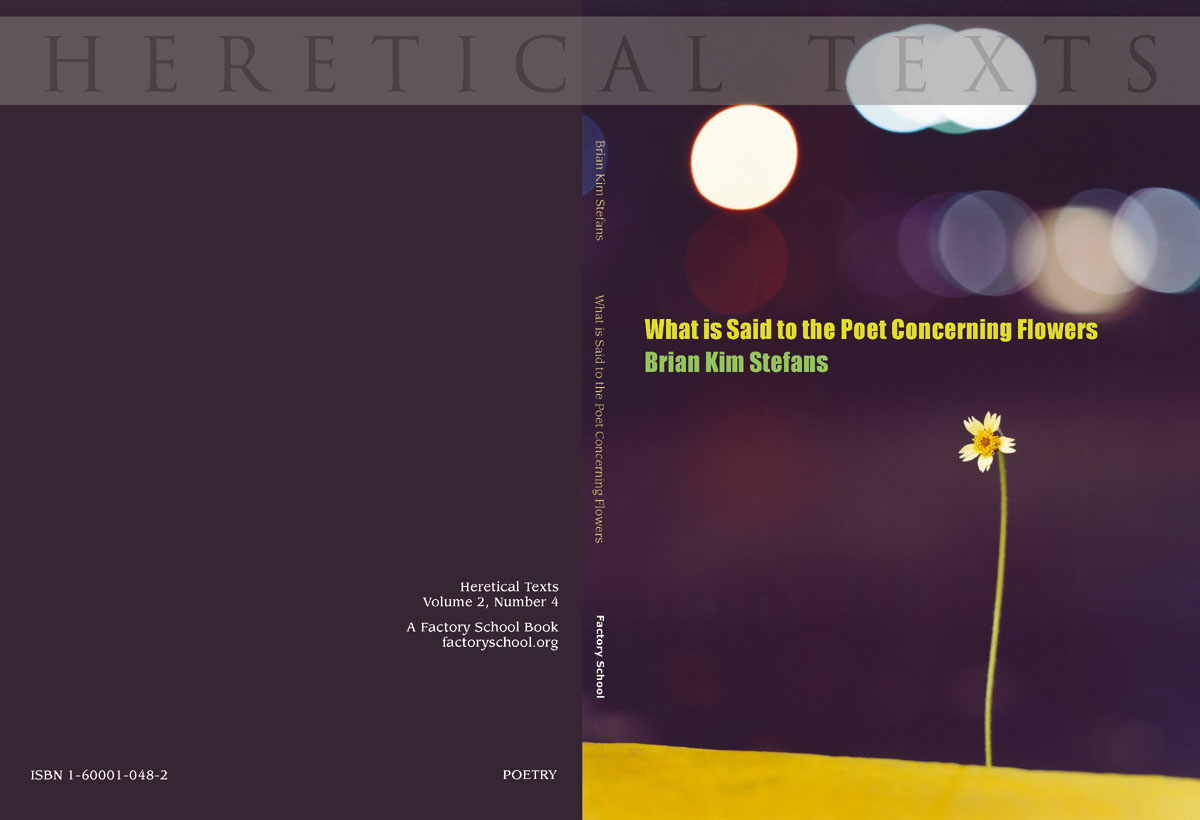
Here’s the cover to the forthcoming book of poems from Factory School’s Heretical Text Series. Photograph by Tim Davis. There appear to be some dust or scratches on this which, from what I understand, do not appear on higher resolution versions.

You will ask why there are no hairless cats or ugly fish on the cover… well, one must have variety, and this is my vegetable course. (Click to enlarge.)

04stefansCOV.jpg

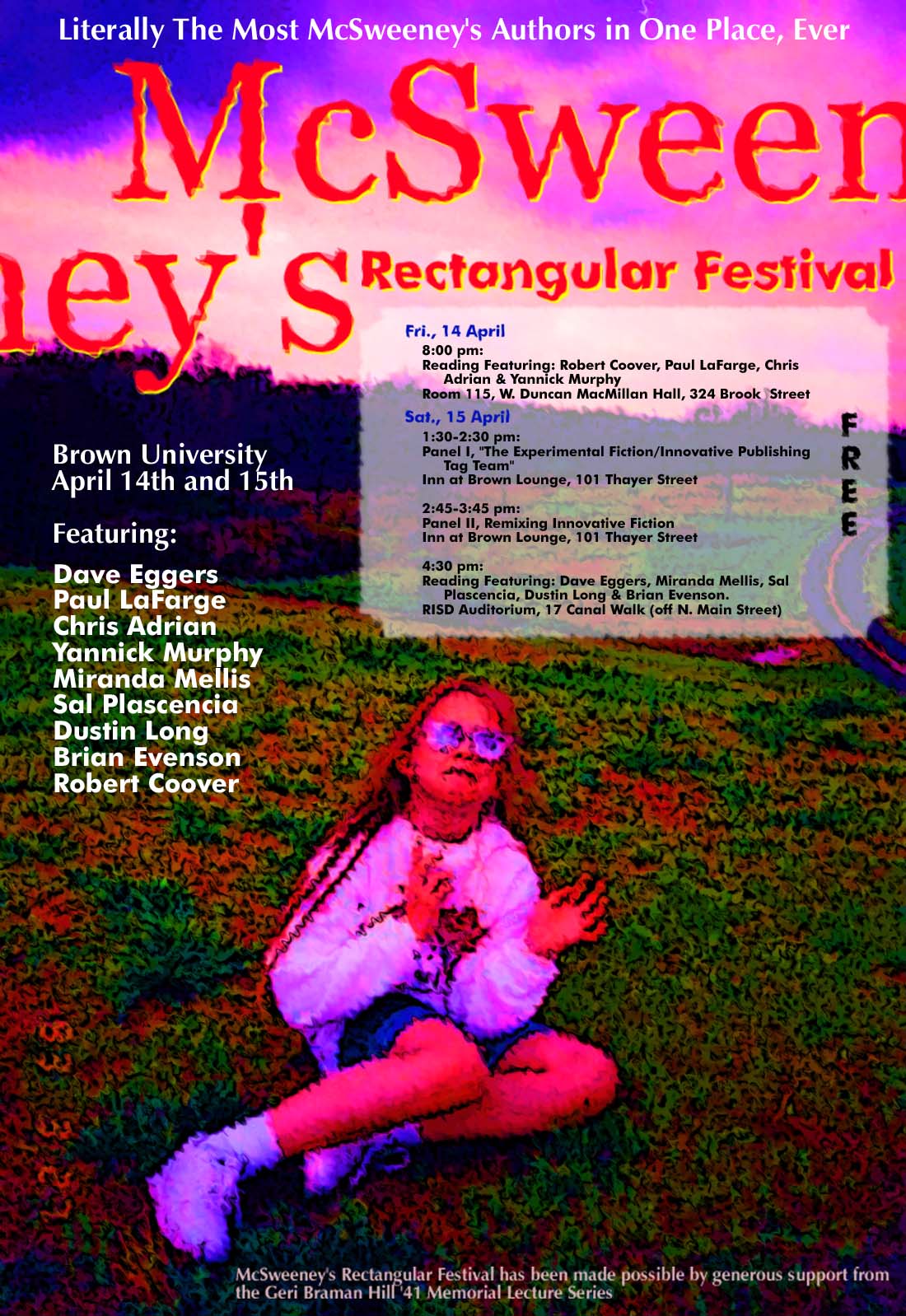
My latest poster design, for a literary conference I otherwise had nothing to do with. It’s a photograph of Alexandra Sears as a child doing something very strange on the side of a hill. Click to enlarge.

mcsweeney_web.jpg

IHF_work.jpg

It’s no secret that I am a huge Ian Hamilton Finlay fan. Finlay died of cancer last Monday at the age of 80. 

I was lucky enough to meet Finlay’s son, Eck, at a poetry reading I did in New York on St. Patrick’s day. I forget exactly what year this was, it must have been 1996, when the holiday fell on a Sunday, or 1995, when it fell on a Friday (the most recent one on a Saturday was 1990, when I was still in college). I was subbing for Melanie Nielson, and because of the holiday the Ear Inn didn’t want to host the reading. In any case, I read to a not very packed house at a tea shop near by with Norma Cole — the only other notable event was that I accidentally brushed dandruff into Jackson Mac Low’s soup, and I met Erica Hunt that day but didn’t know it was her because she sat alone, with her child, at the back (actually, very front) of the room, and I assume she was some woman who stopped by on a whim.

I saw Eck give a talk about his father’s work later that week at Teacher’s and Writers. Because his father was an agoraphobe, Eck used to give talks about his work around the world, which afforded him a great chance to meet poets outside of the UK. I had seen Finlay’s work in a hard-cover anthology of British Poetry that was decades old — the famous Circus poem had blown me away – and Mary Ann Caws, one of my teachers at the CUNY Grad Center years earlier, had leant me some books (she referred to him as one of the two geniuses she had ever met, the other being, I believe, Breton). So, this was a very fortuitous meeting.

I didn’t see Eck much after that, but in 1998 I went to London to spend time with Miles Champion, and while there met Thomas Evans, a good friend of both Miles’ and Eck’s, who invited me to a party at Eck’s apartment in Edinburgh. I remember being keen on seeing a reading in London at the same time at Subvoicive, the sort of equivalent of the Ear series over there, but it was an Ann Waldman reading, so I felt it was probably something I could miss as I’d seen Ann read numerous times already. (I’ll never forget the phone call I had with Tim Atkins about this dilemma — he said “a reading by Ann Waldman or a weekend on the Scottish shore… let me make your decision for you.”)

So I took the train up to Edinburgh. It was packed with football revelers who were rather dismayed that their team, Newcastle, had just lost to Arsenal in some sort of final or other. (Miles and I had been chased by Arsenal fans the night before, so I don’t think winning or losing changes much in terms of how much is imbibed.) It was early afternoon, but everyone on the train was drunk, drunk, drunk, and loud as hell. I knew I would hear it when I got up to go the bathroom, but it wasn’t so bad in the end.

But Edinburgh was a relief. The Scottish cabby who managed to find Eck’s place for me was a dear, or at least compared to London cabbies. The architecture really amazed me, and for the first time on that trip I felt like I was in another country. Not a “Blockbuster” sign in sight. The party was great — I won’t go into details, but there were Gaelic songs, an intoxicated elder Scot with an eye for a much younger lady, the reading of much poetry, and the poet Gael Turnbull, who in a reversal had visited W.C.W. in Rutherford many (many) years before.

(I’ve just learned from Wikipedia that Turnbull, who died in 2004, also created “kinetic poems,” which were “texts for installation in which the movement of the reader and/or of the text became part of the reading experience.” Maybe I should stop believing in coincidence.)

The next day was, indeed, spent driving around the Scottish shore and through the hills of Fife, accompanied by Eck, two friends of his, the daughter of one of the friends named Sinead (who sang several of the Gaelic songs the night previous), and Thomas. I saw cows on hillsides that looked right out of the cover of Atom Heart Mother. We visited an artist who lived in a converted movie theater at the peak of a cliff that overlooked the shore, and I sat with Thomas on that shore as he regaled me with lines memorized from the letters of Jack Kerouac. Only an English poet would bother to memorize such things written in a haze of alcohol as if they were Samuel Johnson, but I certainly never faulted him for it! (Now that I think of it, it might have been Clark Coolidge he was quoting to me.)

We also visited Eck’s childhood vacation home, which was overrun by spiders, and spent a good hour with Eck’s mother, Sue, who helped build Little Sparta. She and Ian, who had known each other since childhood growing up on those hills, were estranged, but both still lived in Fife. I also saw gorse, which is good because now I can use the word “gorse” in poems and sound like I know what I mean, but the opportunity hasn’t yet arisen.

I’m making a short story long, but this really was one of my finest weekends. I have several beautiful photographs to show you if you ever want to visit me.

We did finally get to the garden, the road to which is (if I remember correctly) only marked by the most crude of signs. Eck told me that Ian wasn’t so keen on having visitors because he felt the poems “weren’t there yet” — the foliage had not yet accrued to the degree that was ideal for their presentation. But because I was with Eck — who I didn’t think liked me the night before when I was an uninvited guest but who turned out to be very friendly – we got in. (One memory also from that trip — I sang one of the few songs of my own that I memorized a cappella in the car as we were driving, a feat that will never be reproduced in my lifetime, or in yours.)

We approached the garden, I with great anticipation. It was almost anti-climactic to come upon Ian sitting on a stone bench in his long rubber boots looking at one of his poems right there at the entrance to the place. I would have much rather we had to muck around in his living room looking at stuff while he was upstairs getting decent. Nonetheless, the poem he was looking at was beautiful, and though we barely said anything to each other, I could tell immediately that he was a very gentle and kind man, not quite what I expected for a guy who lost a commission in France because he wanted the piece to be include a long row of working guillotines.

I’d tell you about walking around the garden and all the amazing things I saw, but you can look at the photographs (links below) and get your own sense of what it was like. Specific memories: going into the Temple of Apollo, which had once been a sort of small museum of IHF works but was now closed to the public because Ian had not been able to have it declared a religious site (rather than a cultural site, which is taxed much more). It was now a storage room — I saw several boxes of works that had just been shipped to Finlay from his collaborators (I photographed the mailing label on one of them).

The other memory was of Eck and his lady friend whose name I can’t remember rowing around in the “Sea Eck” in the pond there. She was doing all the rowing, Eck was doing all the talking. Somehow this seemed hilarious to me because she was rather skinny and didn’t look exactly like she was enjoying the imbalance of physical exertion. But that might just have been my satirist’s eye acting up.

The hills are as bare as they appear in the photographs, and the parts covered in the foliage in the garden are as green and rich. The stones you see above, so difficult to photograph, are littered (if that’s quite the word) on the outer edge of the garden, and they read: “The present order is the disorder of the future.” I am not always able to quote this line properly — I even had to look it up just now — because I somehow believe the opposite to be true, but neither version cancels the other out. I’m not sure which is more optimistic than the other; it really all depends on where you sit on the Foucauldian fence (oh god, did I just use the word “Foucauldian”?).

We didn’t see Ian again until we left. There is a photograph in my shoebox of Ian and me with the sun setting behind us — a pretty awful photograph, as the sun really should have been upon us. You can’t see either of our faces very well, but his arms are crossed and I am wearing my famous red gingham shirt. I was too nervous (and physically exhausted, given the previous evening’s drunkenness — my entire London trip’s drunkenness, you won’t be surprised to hear) to say anything significant. But then again, I hardly expected to hit it off right away with Finlay, we are from quite different worlds. I’ve only ever rented, for example. I could have told him that my doctor was William Carlos Williams’ son, but that’s an ice breaker that works on too few occasions. I could have also told him that Robert Smithson was also from Rutherford — their work seems to have something to do with each other — but I didn’t know it at the time.

I wrote an article about Finlay for the St. Mark’s Poetry Project Newsletter which Lisa Jarnot was kind enough to publish. John Tranter republished it in Jacket, and I think it convinced him to have an entire section devoted to Finlay’s work, including a really excellent (much superior to mine) article by Drew Milne. I encourage anyone who reads this blog to take a peek at these articles and also at the links to photographs below.

I don’t have anything terribly profound to say about his work right now, except perhaps that he really enriched my thinking on what it means to be a “postmodern” artist — he was not “postmodern” in any convenient sense of the term, there is/was nothing obvious about Ian Hamilton Finlay, his politics, his aesthetics or his philosophy. He is the first concrete poet I knew whose work actually pointed to a larger world view that was not entirely a meditation on text and its paradoxes, or some easy comment on modern culture – his “vision of sweet philosophy” permeated everything he did, and he created an easy transport between his wee garden in Scotland and the greater (and most frightening) themes of Western Civ.

Ok, that’s a bunch of abstraction for you, but I did use the word “Foucauldian” earlier. He used many of the same techniques that artists like Bruce Nauman (script in neon lights) and several other conceptual and performance artists (words on the side of buildings, on gallery walls, appropriation, not to mention the “crates” event) but it all pointed to some vision that was, on the one hand, sublime, historical and full of a sense of order and the ideal, but on the other anchored in the particular, the ephemeral. The garden may very well sink into ruin, but that seems to have been part of the plan (again, an echo of Smithson here, whose Spiral Jetty was meant to degrade beautifully, then disappear). Most of us are hoping for something a little better than that, at least for the immediate future.

I should mention that his poetry from the pre-concrete days is really great; I highly recommend The Dancers Inherit the Party, published by Polygon in Edinburgh. The following bit, aimed at his arch rival Hugh MacDiarmid (they used the same post office to send blistering letters to each other through the newspapers) is one of my all time favorites, by anyone. (In fact, I rip off one of his moves in the Yoda stanza in “Five Coiled Stanzas” below.)

from Orkney Lyrics 

Mansie Considers the Sea in the Manner of Hugh MacDiarmid

The sea, I think, is lazy,
It just obeys the moon.
— All the same I remember what Engels said:
‘Freedom is the consciousness of necessity.’

Thanks to mIEKAL aND for sending some of these links along to the ubuweb listserv. I append the New York Times obituary since it will eventually become a pay-only piece of reading; I hope they (and Jeffrey Jullich) don’t mind.

Ian Hamilton Finlay’s Garden Gallery
Photography by Philip Hunter
http://www.perlesvaus.easynet.co.uk/hippeis/gallery/little_sparta/

The Little Sparta Trust
http://www.littlesparta.co.uk/

Little Sparta on Flickr
http://www.flickr.com/photos/tags/littlesparta/

The Death of Piety
Ian Hamilton Finlay in conversation with Nagy Rashwan
http://jacketmagazine.com/15/rash-iv-finlay.html

The Mark Scroggins
The Piety of Terror
http://jacketmagazine.com/15/finlay-by-scroggins.html

BKS on Ian Hamilton Finlay
http://jacketmagazine.com/15/finlay-by-stefans.html

Adorno’s Hut
Drew Milne
http://www.jacketmagazine.com/15/finlay-milne.html

Ian Hamilton Finlay on ubu.com
http://www.ubu.com/historical/finlay/finlay.html 

Ian Hamilton Finlay, 80, Poet and Conceptual Artist, Dies

By KEN JOHNSON for The New York Times
Published: March 31, 2006

Ian Hamilton Finlay, a Scottish poet and conceptual artist known for his neo-Classical-style sculptures inscribed with poetic texts as well as for his home and garden, an imaginative echo of ancient Rome in the Pentland Hills of Lanarkshire, died on Monday at a hospital in Edinburgh. He was 80.

The cause was cancer, said Katherine Chan, director of the Nolan/Eckman Gallery, which represents Mr. Finlay in New York.

The famously contentious Mr. Finlay began calling his home Little Sparta in 1980, partly to symbolize his refusal to compromise with the local authorities over whether a building dedicated to Apollo should be taxed as a religious or a commercial structure.

Now maintained by a foundation, Little Sparta resembles the home of an ancient Roman philosopher-poet. Rustic and Classical-style stone carvings bearing literary quotations have been carefully placed throughout the property. One stone block, seemingly antique and tilted in the ground as if it were a ruin, presents the neatly chiseled words of the French revolutionary Louis de Saint-Just: “The world has been empty since the Romans.”

But the grounds are not completely given over to nostalgic traditionalism. Images of 20th-century warfare are also distributed about. The two posts of a stone-and-brick gateway, for example, are each topped by an oversize stone carving of a hand grenade.

Mr. Finlay conceived and designed his sculptures, but hired craftsmen to produce them. He also created works for exhibitions in Europe and the United States and for public commissions. Although he had agoraphobia, which restricted his traveling, he had an internationally recognized career, and many visitors made the pilgrimage to Little Sparta.

Mr. Finlay was on the short list for Britain’s Turner Prize for contemporary art in 1985 and received the honorary appointment of a Commander of the British Empire in 2002. His work was selected to be part of the 2006 Tate Triennial, a survey of British contemporary art now on view at Tate Britain in London.

Ian Hamilton Finlay was born on Oct. 28, 1925, in Nassau, the Bahamas, where his father was a bootlegger who smuggled rum into the United States during Prohibition. At 6 Mr. Finlay was sent to boarding school in Scotland. War cut short his education at 13, when he was evacuated to Orkney, an archipelago at the northern tip of Scotland. As a teenager he briefly attended the Glasgow School of Art before being called up in 1942 for duty with the Royal Army Service Corps.

After the war, Mr. Finlay worked as a shepherd while producing paintings; short plays, which were broadcast by the BBC; and stories, which were published in The Herald of Glasgow.

In 1961 Mr. Finlay founded the Wild Hawthorn Press, which initially published contemporary poets like Louis Zukofsky and Lorine Niedecker but later focused mainly on Mr. Finlay’s poetry. In the early 60’s he became interested in concrete poetry, in which the visual appearance of words was meant to count as much as the literary meaning. He also began producing short poems sandblasted on glass. One read simply, “Wave Rock.”

In 1966 Mr. Finlay and his second wife, Sue, moved to the cottage and grounds that would become Little Sparta, a patch of highlands then called Stonypath, 30 miles southwest of Edinburgh. It was to be his home for the rest of his life. Mr. Finlay’s marriage to his first wife, Marion, ended in divorce. He is survived by his wife and their children, Alec Finlay and Ailie Simpson.

Today visitors to Little Sparta are greeted by a bronze plaque mounted on a brick wall that nicely sums up Mr. Finlay’s independent, high-minded and mercurial spirit: above the imposing, precisely modeled image of a machine gun, sentiments from the poet Virgil read, “Flute, begin with me Arcadian notes.”
Another poem “about” me, or at least the letters in my name. Came in last week, soon after the aforementioned Korean food day, but I decided to wait as, well, I can’t just post poems “about” me on this website. This one is by Juliette Lee, one of the authors of the group poem below.

She is, besides being an MFA student at UMass, the inventor of “gochunaise,” a “spicy red pepper paste spread that folks can use to make egg salads and the like.” When I was very little, my mother used to refer to my pee-pee as my “gochu,” so, um, I’m not sure how I feel about this.

I, by the way, have invented “bulgoka,” which is a cross between baloney and bulgoki. Yum.

Bring It 

Burned, rioted, idolized, annulled, new.
Koans impeach my star-terrified eyes,
fractious and now soluble.

But reticulated imminence announces, “Never
kill in mourning.” Surely triumph
elegizes for all (non)native speakers.

Bring rain in a new kiln,
(inside, manmade stereophonic
tremors). Emerge forgotten. Another
nearby story

begets runaways. Is anything
nonprofit? Kneel into my
sentence. Try escape. Framed
and now stable.

[Here are some old notes I had made last year prior to going to a “thinktank” on electronic writing at the University of Iowa.]

1. Criticism seems never to deal with affective issues of the art — when a piece strikes you as unusually compact, sharply ironic, aggressive (can new media art be truly aggressive in the way limited analog video tapes can be?) the text is not anaylized beyond whether it is more or less suitable for the piece.  New media art is usually positioned as explaining an abstract principle related to other facets of new media rather than experienced. Art is given the task of illustrating a critic’s ideas, which doesn’t leave a lot of room for the artist to create new ideas.  Too much concentration on large works with pretensions of dealing with some large linguistic issue, for example.

2. I don’t care about the relationship of the human to the machine as a theme for work.  Perhaps the romantic approach to art, “subjectivity” that matters rather than the abstract idea of “subjectivity,” is truly gone, but that leaves a whole lot of people who don’t have computers out of the equation.

3. Has the myth of new media adequately adopted the mantle of Surrealism, Existentialism, and homegrown, but hardly philosophical, products like Abstract Expressionism and the Beats?  Or more importantly, Situationism and/or Marxism?  Rather than being a continuous self-critique — new media art being dystopic in the face of proposed utopic program — is new media prepared to be a life philosophy in the way previous paradigms of art tried to be?

4. New media artists should not give powerpoint presentations about their art.  It stands between the artist and the audience, when in fact the goal appears to have been that the audience gets a crack at the artist in his/her presence.  Also, it destroys the enigma.  I think occasionally that the enigma is corrupted by too much explanation, but digital art is often poised as an explanatory process.

This must be a week devoted to writing poems for our about me. I’ve just discovered an odd bit called Brian Kim Stefans (Nebraskan Misfit) at a blog called carton’s book of merz, with the notable line “as shed gecko permutes us.”

I heard earlier in the month that I am included in Kent Johnson’s massive book Epigrammatitis: 118 Living American Poets. It’s 266 pages and “fully illustrated.” I’d buy it except that 1) I almost never buy books anymore, being broke, 2) I suspect that his epigram about me is somehow telling me I’m a weenie even if it seems ok on the surface, or 3) several epigrams directed to my friends are simply telling them they are weenies. Of course, there is also the possibility of 4) severeal epigrams directed at people I don’t like are telling them they are weenies, but there aren’t a lot of people I don’t like, and I’m not sure I’d want to wish a Kent Johnson epigram on any of them.

And earlier today I had three poet friends over for Korean food: Ryan Dayley, Lynn Xu and Juliette Lee (who brought the food) and they got it into their heads to write me an elegy, which appears below. I’m not sure I deserve such, uh, affection? I’m just glad I “excited the cherries” though I wonder if I could be arrested for that. 

An epigram, an elegy and being called a “Nebraskan misfit” in one week must be some kind of record. I feel almost as fulfilled and recognized as a Flarf poet!

An Elegy for Brian Kim Stefans

A cherry grenade, high tops, yellow pads, marzipan.
Between a coover and a morrissey, lies compromise
And then they loved him.  And they embraced him, over the high fences.
As a snowcone in a hurricane then high tide!
Holy rollers, mine bicycle placates my tubular maneuver
And then the fog came.  And then the flowers.  The flaming stroke. 
Softer rocket how. Made up sweeteners, a sleepy eye.
Galant Russian exports, thrust fist German into lunfardo vocality
And then the healers for cooler love, invoked a more radical God.
An out of key panda cub gave it up first. She said.
Plug it in and it gets public
And then they loved him.  And in the vast plains, the braver flames.
Golden monkey, sing it again.
For coin, couldn’t see the cup’s bottom
And in the sex of the players.  And over the bleachers.  Excited the cherries.

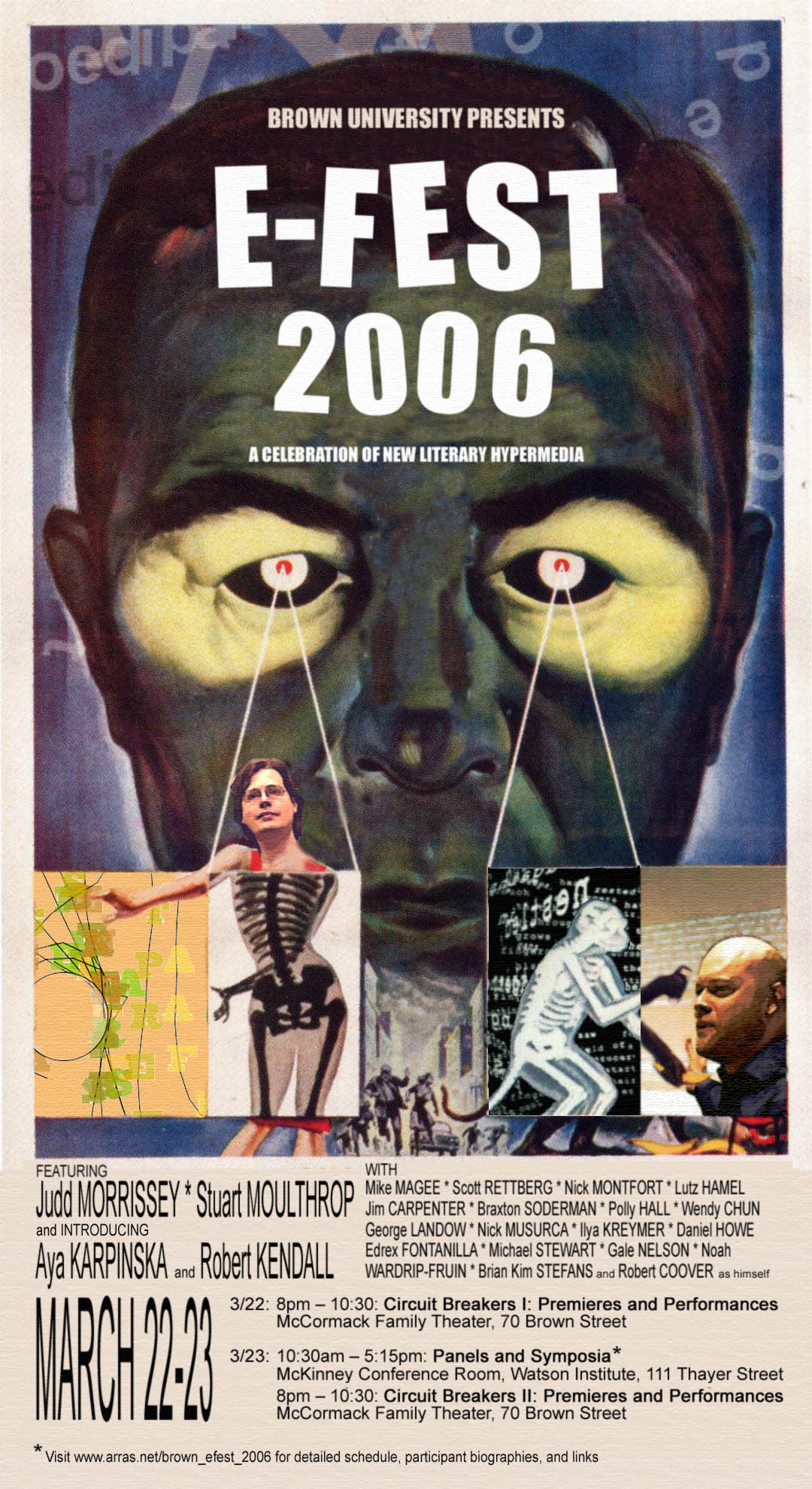
Check out the poster I designed… click to enlarge.

brown_efest_poster_FINAL.jpg

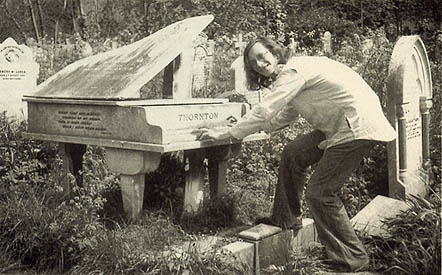
People have wondered why I like the poetry of Australian writer Martin Johnston so much. It’s purely because of this photograph:

mj-piano.jpg

One of the few poets who can join the ranks of the hairless cat and the deep sea angler as exotic, sepulchral creatures without even trying. But seriously, he was pretty good, and even his novel was ok. There’s a lot of his stuff at Jacket including a not very good article about him by me.

I’m working on creating a piece for Brown’s Cave, a 3D environment here that I don’t feel like explaining now (but if you want to find out about it, check out the Brown Cave Writing class website).

Basically, the idea is that you would maneuver around an environment that kind of felt like the International Space Station, or maybe a small solar system. Machines made of words would revolve around you, and as you moved past them, you’d hear bits of audio that suggested what these little poem machines had in them.

Here’s a little Maya demo movie of this first part.

Once you clicked on a poem, it would unfold before you, and you then had the ability to cycle through the subpoems, little surreal things that were written based on where the letters fell when you moved the lines about. Like the below (click on the words to move to next poem).

The full proposal can be found here: Ouija Poems.pdf. Well, I think it’s a cool idea.

[Some responses I wrote this evening, in a semi-drunken stupor, to Mark A. Cantrell, who wrote asking me about my setting of Christian Bok’s Eunoia. Nobody’s really asked me about this in the past, so I thought to post them, why not.] 

Thanks for contacting me on this. I’m always surprised that people have been so interested in my setting of that part of Eunoia because I actually never thought it that successful, though my favorite part of it is that part you pointed out, the fact that the text goes downright woggy after you hold down on the button. Let me just address the few initial questions:

> First, do you or did you ever have any plans to create settings for any of the other chapters of Eunoia? If not, was there a particular reason why you chose Chapter E?

I did think of doing all five chapters but I realized that with each chapter I’d have to come up with something quite original, and I frankly didn’t have the time, but also, I wasn’t sure that it really added anything to the text. Unlike with Bembo’s Zoo (which you should Google) to merely add an animated interactive dimension to the text didn’t seem to be enough.

Also, to do a justifiable animation to, say, the “o” chapter would have required doing something different with every “o”, not just fade every paragraph into the next, and I didn’t think it was worth the effort. If I had time at a later date to do each chapter, I would, but then I would have to redo chapter “e” because I didn’t think it was that successful. If I had done something amazing with chapter “o” (for example) I would have had to go back and redo the chapters I had already done (which is what happened with “The Dreamlife of Letters,” which took me 6 months).

No particular reason why I chose chapter “e”. Perhaps that’s what Christian sent me. Frankly, I don’t remember. Maybe it was the longest chapter (certainly at that time, see below) so it was the most obvious choice. I don’t remember at all. >I noticed that your setting combines the Chapter E of the book with the part entitled “Emended Excesses.” Was this your decision or one made in collaboration with Bok? What were some of the reasons for this choice?When I did the piece, that part of the book was part of Chapter E. Christian later moved it to the appendix.> Finally, do I understand correctly from the 2001 date on your site that the Flash setting was made available at approximately the same time that Coach House Books published the book version?

Probably not. I think I did my bit at least half a year before the book reached print. But I could be wrong about this. Certainly a few months. Thus the discrepancy noted above.

When I launched the piece, Marjorie Perloff complained about the aspect that let you send the text into a tizzy. But I was more interested in the fact that, when you moved backwards through the text after sending parts into crazy activity, they just rested there, and faded into each other, and it reminded me of walking through the ruins at the World Trade Center after 9/11, coming across these strange wreckages through the fog, one after the other (or maybe walking through any sort of ruin, like in that movie “Excalibur”). I guess this means that the piece was done after 9/11, if that means anything.

I was accused, in my piece for the Inkblot Record, of doing too much “violence” to the text (in that case Dan Farrell’s) and I think that’s what Perloff was accusing me of this time. But frankly, I think this is totally untrue.

Text, once it reaches a digital realm, is always vulnerable to this sort of “violence” — think of the pornolizer or the shizzolator, or anthing sort of text that is screwed up by digital technology (in cell phones, for example) — and so I was merely illustrating the type of violence it could succumb to, but in a friendly, aesthetic way. Of sorts, I suppose. I was simply introducing the text to the digital realm in a “tough love” sort of way, not subjecting it to the sort of abuse that putting it out there, in HTML (for example) might subject it to. I thought it looked great. A Google search is, in this light, more violent than anything I did with it.

Anyway, a few answers quickly before I go to sleep… thanks for asking!

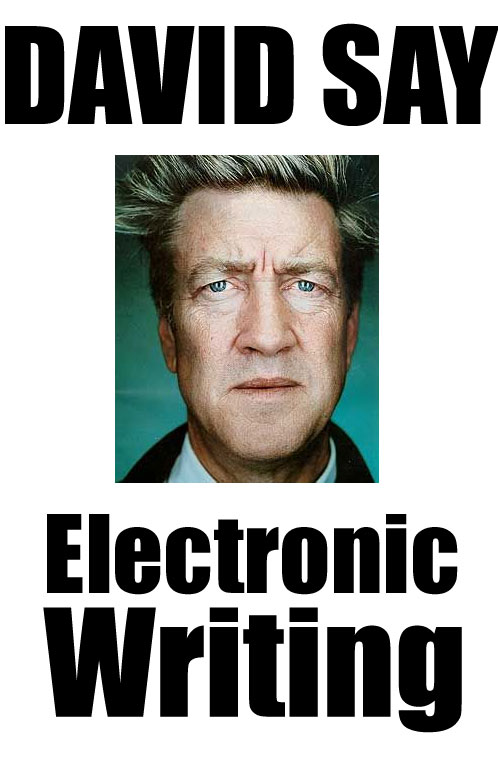
The idea was inspired by two things: 1) a visit last semester by David Lynch in support of his new Transcendental Meditation / World Peace foundation, and 20 the “Frankie Says” t-shirt campaign that happened in the eighties centered around the band Frankie Goes to Hollywood. Perhaps Apple’s “Think Different” campaign was behind this also.

My idea was to attract students from many different disciplines to the class, so I used major figures in various genres to throw their weight behind us. For good measure, I included Frank Sinatra and a splat of paint.

If you ever get the urge to proselytize for electronic writing – and I know you do, frequently – these are easily printable, so you can poster your campus, office or local coffee shop. Click to enlarge.

alan_say.jpg

zora_say.jpg

karlheinz_say.jpg

splat_say.jpg

ezra_say.jpg

frankie_say.jpg

jack_say.jpg

sylvia_say.jpg

johnny_say.jpg

ludwig_say.jpg

david_say.jpg


I didn’t think the site would get so popular so soon… but someone has been so kind as to create a mirror of the site in, I don’t know, Germany?

http://www.unbehagen.com/mirror2/mirror.php?url=www.arras.net/fscIII/

It’s definitely worth checking out.

This one reminds me of my Flash Polaroids… and it’s named after a Robert Altman film.

Three Woman

I count more than three, don’t you?

Other fun things from the Scenes of Provincial Life. 

My Dad… I’m proud of him! (Now I have a new place to publish my Ron Silliman editorials… ONLY KIDDING.)

bp20143.jpg

John Stefans, a former reporter for The News-Review, is returning to the newspaper as its editor, succeeding Denise Civiletti.

Ms. Civiletti said she is stepping down as editor in order to devote full time to her duties as co-publisher of Times/Review Newspapers, publishers of The News-Review and three other community papers, The Suffolk Times, The North Shore Sun and The Shelter Island Reporter.

Before joining The News-Review as a reporter, Mr. Stefans was editor of the Traveler-Watchman of Southold. He moved to South Jamesport full-time six years ago after retiring from Chase Manhattan Bank, where he was senior vice president and director of corporate communications. He attended Fordham University and served on active duty for three years as a U.S. Army correspondent. After leaving The News-Review, Mr. Stefans worked as an assistant to Riverhead Town Supervisor Phil Cardinale from July 2004 to May 2005.

“John’s leadership abilities, reporter’s instincts and accessible writing style make him a perfect choice for us,” Ms. Civiletti said. “John has a passion for the Town of Riverhead and its people. He takes great pride in his community, and that’s important to us.”

Mr. Stefans and his wife, Karin, now live in Riverhead. They have five children.

I once made the joke that the Four Horsemen — the sound poetry group that included Steve McCaffery, Paul Dutton, bpNichol and Rafael Barreta-Rivera– would be appearing in NY at my digital poetry event. What I really meant was that these guys – which I found on a Swedish children’s site that I highly recommend for adults – would be appearing.

Click away and be treated to a fabulous sound poetry concert in the tradition of the Ursonate and Meredith Monk, with a touch of Steve Reich’s Tehillim. (I don’t know why I can’t make it bigger…)

« Previous PageNext Page »