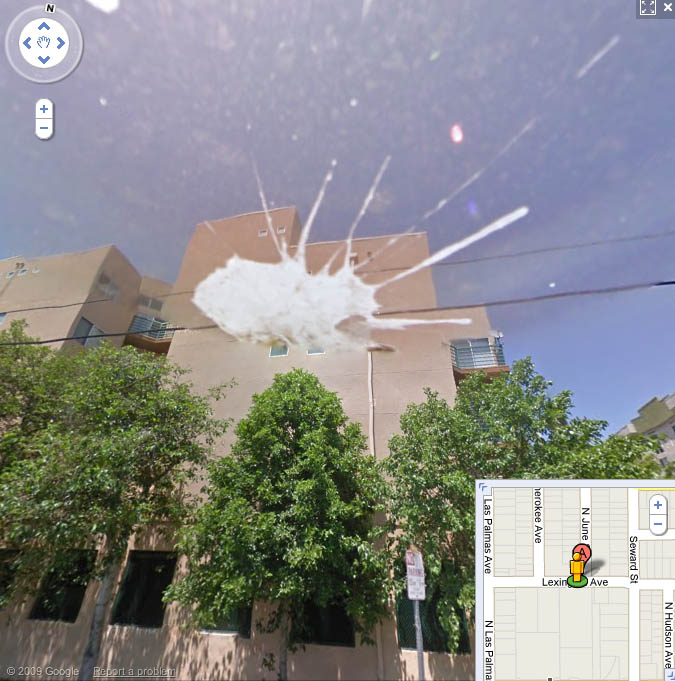
So there I am, checking out a possible new apartment building in Google Maps, and I think I see some exploding rays of white light — you know, like a UFO — emerging from the second floor.

I move a few clicks down the street to get a better angle, and notice the rays of light have not changed their position relative to my own change of position… because, in fact, the rays are bird poop.

I guess it’s not as interesting as catching a drug deal or seeing your mom on Google maps, but it does in its way reveal the machinations behind these absorptive, seemingly omniscient technologies.

If you want to visit the poop, type in “hyde park apartments los angeles” in the search field at Google Maps. When you get there, go to street view, click left to get on Lexington Ave, then click forward to move down Lexington (actually, backwards works, too). Swing the camera up and to the right — UFO! (Poop.)

Today was one of those fugged up days when you sit around and go through your Abe.com and Amazon.com shopping carts, prune them (“save for later”), go back and forth between the sites looking for the best prices, and buy a shite load of stuff, some of which costs all of $0.01 (shipping: $3.99). That’s what it’s like to be a poet–and a poet researching the writing of Los Angeles is bound to get some good deals!

So this is what I bought today, just FYI (content for this blog rarely comes from deep insights from the author, but from the capriciousness of his actions):

L.A. Exile: A Guide To Los Angeles Writing 1932-1998
Evan Calbi, Paul Vangelisti, editors

Place as Purpose: Poetry from the Western States
Martha Ronk, Paul Vangelisti, editors

Last Words
Guy Bennett

Alphabets: 1986-1996
Paul Vangelisti

Lee Sr. Falls to the Floor
Leland Hickman

Fine Printing: The Los Angeles Tradition
Ward Ritchie

Mavericks: Nine Independent Publishers
Richard Peabody

Geographies
Robert Crosson

Art of Engagement: Visual Politics in California and Beyond
Peter Selz

Abandoned Latitudes: New Writing by Three Los Angeles Poets
John Thomas, Robert Crosson, Paul Vangelisti

Stand Up Poetry: The Anthology
Charles Harper Webb

La Medusa
Vanessa Place

Musical Metropolis: Los Angeles and the Creation of a Music Culture, 1880-1940
Kenneth Marcus

Grand Passion: The Poetry of Los Angeles and Beyond
Charles Harper Webb

North America Book Of Verse, Volume Three
C. F. MacIntyre

The Garden Prospect: Selected Poems
Peter Yates

Specimen 73 : a catalog of poets for the season 1973-74
Paul Vangelisti

Footnotes & Headlines: a Play-Pray Book
Sister Corita

Nevertheless
John Thomas

Remote Control: Power, Cultures, and the World of Appearances
Barbara Kruger

Invocation L.A.: Urban Multicultural Poetry
Michelle T. Clinton, Sesshu Foster, Naomi Quinonez

Bohemian Los Angeles: and the Making of Modern Politics
Daniel Hurewitz

Selected Fiction/ Collected Later Poems/ Selected Criticism and Essays
James Boyer May

This last one, a boxed set, is far and away the most expensive, but the books are really beautiful, and I don’t think more than 100 copies were created. I’ll have to write some serious criticism about May to bring the price up!

Most of these are books that 1) I couldn’t get in the UCLA library, 2) were so cheap that, even if I could find copies, I just wanted one, 3) were selling for a lot less than it appeared they were worth based on competing prices, or 4) in my twisted mind were just so cool I wanted one for myself.

The Electronic Literature Organization and Brown University’s Literary Arts Program invite submissions to the Electronic Literature Organization 2010 Conference to be held from June 3-6, 2010 in Providence, Rhode Island, USA celebrating Robert Coover.

Deadline for Submissions: January 15, 2009
Send to: elo.ai@eliterature.org
Notification of Acceptance: February 25, 2010
PLEASE NOTE: We will still aim to receive full papers by May 1, 2010.

For more details, please keep checking the website:
http://ai.eliterature.org

We welcome:

  • Proposals for critical/academic papers relating to the topics and themes set out on the site. Submit an abstract – about 300 words, 500 word maximum – with title and brief bio (indicating affiliation, if any).
  • Proposals for performative or artistic presentations, including readings and artist talks. Submit a description and or artist statement – totaling about 300 words, 500 word maximum – and include a brief bio (indicating affiliation, if any).
  • ‘Panel’ proposals – about 300 words, 500 word maximum – but note that these will be folded into ‘Seeded’ sessions. (More on this soon.)
  • Proposals for the Arts Program which will focus on installable work. Submit a description and or artist’s statement – totaling about 300 words, 500 word maximum – and include a brief bio (indicating affiliation, if any).

Alternative, innovative proposals through which we will attempt to diversify the format of the conference. Submit a description of about 300 words, 500 word maximum.

NB. If you send illustrative, digitized AV materials, either keep these (byte-wise) small and short, or send us links.

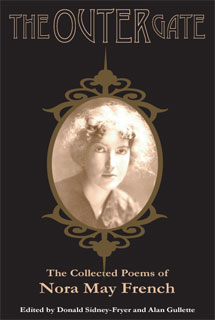
It’s strange to me that the same month that sees the publication of Tiresias: The Collected Poems of Leland Hickman would also see the poems of Nora May French in book form.

I came across French in the first few days of my research into Los Angeles poetry, trying to track down publications in the UC libraries and so forth, but found them hard to come by. Dana Gioia included some poems of hers in his anthology (co-edited with Chryss Yost and Jack Hicks) called California Poetry: From the Gold Rush to the Present, but otherwise she doesn’t appear in too many contemporary anthologies (such as the excellent volumes of 19th Century Poetry from the Library of America).

French wasn’t terribly prolific, and she died at the age of 26; about 100 pages of this collection is of her poetry, the rest being a long biographical essay, several remembrances and miscellaneous reviews of her work, many of which were more concerned with her dramatic death by suicide than the quality of the poetry.

I’m not sure that too many readers today will find her poetry exceptional, at least those that don’t have at least some fondness for writers like A.E. Housman and the poets of the Nineties (Lionel Johnson, Ernest Dowson, etc), or poetry by women of the early part of the century, such as Sara Teasdale and Edna St. Vincent Millay. (John Wilkinson has written a really nice essay about John Wieners particular fondness for women poets such as Teasdale, but I don’t think French makes an appearance in that. It appears in his excellent collection The Lyric Touch.)

She couldn’t be considered an “early Modernist,” and even a much older writer like Edwin Arlington Robinson makes her seem old-fashioned, but this isn’t suprising considering the rather provincial nature of Los Angeles at the time (population around 300, 000). She moved to San Francisco and eventually Carmel in the last year of her life, though did spend a year studying painting in New York.

I actually enjoy trying to puzzle through these occasionally cramped, overwrought verses, and I think she compares favorably to more fluid writers in her circle such as George Sterling. She had that urge for gem-like porfection that Pound admired in Theophile Gautier, which is not something I see in a lot of early American poetry. If anyone I’d compare her to, it would be someone like Sylvia Plath, as, indeed, she was quite obsessed by death in her last years, and her poems are incredibly economical, with really very little time to spare on the niceties of literary ornament.

This very short one is metrically a little daring for her, as she preferred standard ballad meters for most of her work.

Vivisection

We saw unpitying skill
In curious hands put living flesh apart,
Till, bare and terrible, the tiny heart
Pulsed, and was still.

We saw Grief’s sudden knife
Strip through the pleasant flesh of soul-disguise—
Lay for a second’s space before our eyes
A naked life.

Kind of has a Thomas Eakins (i.e. The Gross Clinic) element to it, but also reminds me of certain Plath poems such as “Morning Song” that seem ambivalent about the relative values of birth and death. There was, apparently, a number of light, humorous poems of French’s that were destroyed by her family after her death as they didn’t seem “poetic” enough, which is too bad since she often seems rather humorless in the poems that remain. The few humorous poems in this collection are very good.

The publisher, Hippocampus Press, is mostly known for work in the H.P. Loveraft vein; I think French got on her list due to her friendship with George Sterling and the appreciation of her work by Clark Ashton Smith. Below is the press copy:

Nora May French (1881-1907) is an enigmatic and ethereal figure in American poetry and in the poetry of California. Born in Aurora, New York, she came to Los Angeles with her family when she was a little girl, and in the course of her brief and tragic life she lived and wrote more intensely than many who live a full span of years. Her poetry possesses its own kind of cosmic consciousness, aligning it with the work of Clark Ashton Smith and her friend George Sterling. Its delicacy and pathos render it an imperishable monument to the throbbing emotions and aesthetic sensitivity of the woman who, although beloved by all in Sterling’s Bohemian circle, suffered keenly from her own love affairs and committed suicide in November 1907. Now, more than a hundred years after her passing, her poems have been gathered in this volume for the first time. The book includes an extensive biographical and critical introduction by Donald Sidney-Fryer, tributes to French by her contemporaries and by later admirers, and a selection of reviews.

Nora May French published no books in her lifetime, but her Poems were assembled in 1910 by George Sterling and others. That volume, however, was incomplete, and many fugitive poems have been added by Donald Sidney-Fryer and Alan Gullette, two of the leading authorities on California poetry and the poetry of fantasy and terror.

A sequel to an earlier group of Los Angeles PDFs. My apologies for the occasional crappiness of some of these scans, but I’m often using books with delicate or really restricting binding.


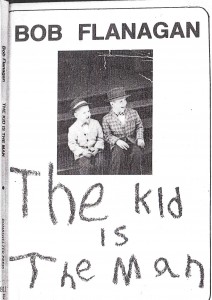
flanagan_cover

Bob Flanagan, The Kid is the Man
(Bomb Shelter Press, 1978)

Early poems by an artist better known for his extremely masochistic performance work, written around the time when he was hanging out at Beyond Baroque with the Little Caesar crowd. I posted a later collaboration of Flanagan and David Trinidad, A Taste of Honey, elsewhere on this blog.

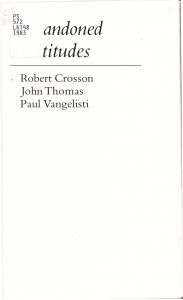
abandoned_lattitudes_cover

Abandoned Latitudes, by Robert Crosson, John Thomas and Paul Vangelisti
(Red Hill Press, 1983)

This is a very excellent and various collection of writing by the three authors. Crosson is an under-appreciated Los Angeles poet who writes in a sort of fictional quilt style, which is to say, it is very much “collage” work but based on his own skewed narrative imagination. Selections of his Daybooks were recently published by Otis Books/Seismicity Editions.

Paul Vangelisti, of course, was the editor of Invisible City, an important journal of poetry from the seventies and eighties (among other several other excellent editing and translation ventures before and since) and is a prolific poet whose selected poems, Embarrassment of Survival, appeared in 2001. Here is an interesting video of his recent interview with Ezra Pound’s daughter, Mary de Rachewiltz.

I posted a collection of John Thomas’s poetry elsewhere in this blog. This “unfinished” prose sequence is by turns beautiful and harrowing, sounding at times like Bruce Chatwin’s In Patagonia and George Bataille’s The Story of the Eye. It also reminds me a bit of that Jack Nicholson movie Five Easy Pieces, though I don’t know why — I guess I keep expecting Toni Basil to appear suddenly in it.


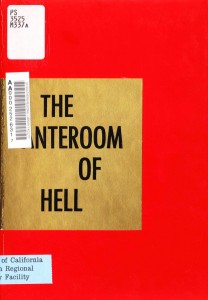
anteroom_cover

William J. Margolis, The Anteroom of Hell
(Inferno Press, 1957)

These poems can seem, at times, like a parody of typical “Beat” poetry of the time; as the title of the book suggests, it is full of visionary, stream-of-consciousness condemnations of conformity and modern life, as well as lofty, faintly archaic paeans to love. There’s more than a bit of Gregory Corso and Arthur Rimbaud traipsing around these pages, though without the humor; Jim Morrison probably read this as a teen.

It’s actually a pretty enjoyable read, especially given the historical context, as the author was a key figure in the Venice West scene and a occasional collaborator with Wallace Berman on Semina. The book itself is a beautifully printed, which might come through in the .pdf, or not.

cointet_a_few_drawings_cover

Guy de Cointet, A Few Drawings
(1975)

I posted a video of Guy de Cointet’s theater on Youtube. There are actually several great resources about this French-born Los Angeles artist on the web, such as here and here and here and here, as well as a cache of .pdf reprints of various essays and reviews about his work. I also posted a photo and brief intro to his work elsewhere.

This collection of “drawings,” which are really more like concrete or visual poems and are quite hilarious, confirms for me the rightness of calling de Cointet a “poet” (even if, in this time of conceptual literature, I hardly have to break a sweat to make that argument). A full list of his compelling, but extremely expensive to procure, publications can be seen here.

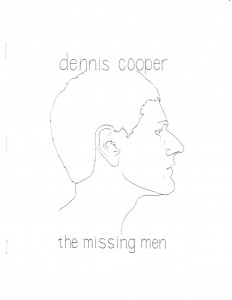
cooper_missing_men_cover

Dennis Cooper, The Missing Men
(Am Here Books/Immediate Editions, 1981)

A really beautiful, simply but elegantly produced collection of early poems and very short fictions by the well-known author Dennis Cooper. Cooper’s own website suggests that all of the issues of his seminal journal Little Caesar appear online in pdf form, but this turns out not to be the case, though I do love the first page of the first issue which lays out their editorial philosophy:

In Paris ten year old boys clutching well worn copies of Apollonaire’s ALCOOLS put their hands over their mouths in amazement before paintings by Renoir and Monet. Bruce Lee movies close in three days. This could happen here.

levitt_running_grass_cover

Peter Levitt, Running Grass
(Eidolon Editions. 1979)

I don’t know much about Peter Levitt, but found his poems in a couple of Bill Mohr anthologies and appreciated them for their quietness, formal integrity and detail. From what I know, he is living in the Bay area now, but certainly lived a great portion of his younger years in L.A. This book has a nice, short introduction by Robert Creeley.

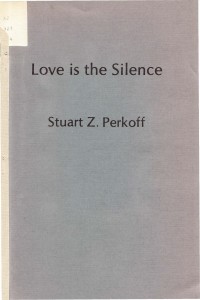
perkoff_love_cover

Stuart Perkoff, Love is the Silence
(Red Hill Press, 1975)

Ah, Stuart Perkoff… probably the most well-known of the many poets in Los Angeles who never fully realized their talent (Nora May French being the first). He figures prominently in Lawrence Lipton’s The Holy Barbarians (several photographs of him appear in the appendix, along with the likes of Los Angeles residents Lawrence Ferlinghetti and Kenneth Rexroth… haha, that’s another story), as well as in the later, very interesting scholarly study of the Los Angeles arts scene in the sixties, Venice West: The Beat Generation in Southern California, by John Arthur Maynard.

Even better, though, is that he is the one Los Angeles poet to appear in Donald Allen’s New American Poetry in 1960, and his collected poems, Voices of the Lady, was published by the National Poetry Foundation in 1998, though now appears out of print.

This selection was made by Perkoff and Paul Vangelisti a few years before Perkoff’s death. Like the poetry of Margolis, it might seem a bit dated in style, but in fact, after a few reads, Perkoff’s distinct personality, which is not lacking humor or irony, and the sureness and playfulness of his formal talents come through. Olson was a big fan, and in some ways, he’s kind of like the West Coast Paul Blackburn.

I really enjoy this book for the image it gives me of some aspects of life at Venice Beach in that time of oil derricks, “jazz canto” and extensive drug use — by turns “existential” in its despair but cosmic, infused with a giddy, bohemian light. (Well, I’ll give describing his poetry another shot later.)

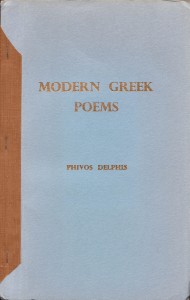
Phivos Delphis, Modern Greek Poems
Translated by James Boyer May (Villiers Publications, 1954)

Just throwing this up for you James Boyer May fans. I don’t know much about the poet he is translating, but though these “versions” are a bit archaic and stiff sounding, they fit together another piece of the puzzle of this nearly unknown poet. I put his Selected Poems: 1950-1955 on this blog earlier.

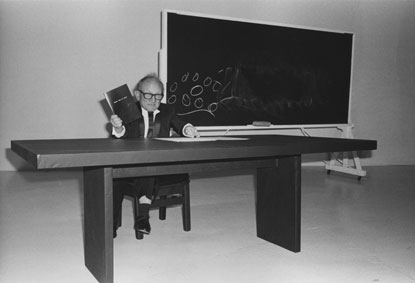
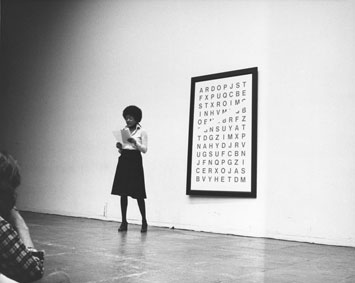
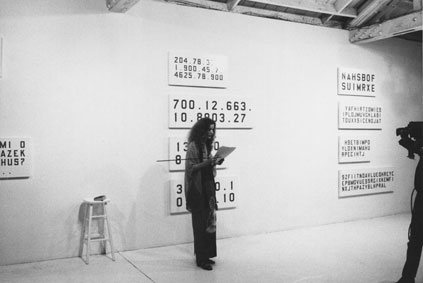
Here’s a clip from a performance by the artist/writer Guy de Cointet, who I mention in my roundup of Los Angeles poets. It’s almost impossible to find work by de Cointet in print — any help in this area would be much appreciated!

http://www.youtube.com/watch?v=HAawW3tFVwc

gdc_espahor

gdc_halvedpainting

gdc_srummel

This page has some photos from his other performances.

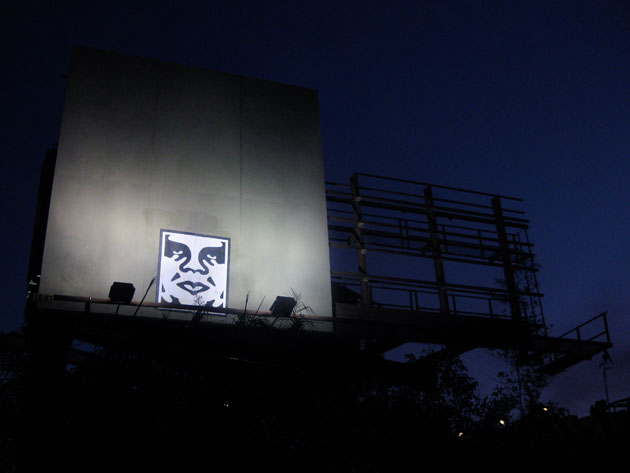
obey_andre_the_giant_has_a_posse_001

This has been on the billboard for the past several months. I knew I’d find an image of it on Google. Better than having Zac Efron staring at me in my jammies.

los_angeles_poetry_cover

Los Angeles Poetry I
(Villiers Publications Ltd., London: 1958)
Edited by James Boyer May, Thomas McGrath and Peter Yates.

This is the representative collection by what I loosely call the HUAC generation — both McGrath and Edwin Rolfe (who doesn’t appear here) were either fired or blacklisted due to their political views, and others in the collection were affected by McCarthy-era madness. An interesting study and anthology of this group of poets (though not including the avant-garde or non-political ones) is Poets of the Non-Existent City: Los Angeles in the McCarthy Era, by Estelle Gershgoren Novak.

Included in this collection is a weird, Joycean poem by the eccentric Philadelphia writer Gil Orlovitz (who frequented Hollywood as an a screenwriter; CA Conrad is a big fan, and you can read about him on Conrad’s blog), poems by surreal, experimental photographer Edmund Teske, a large slab of McGrath’s Letter to an Imaginary Friend devoted to the pleasures of sex, early work by the well-known poet and teacher Ann Stanford, and spare, compelling work by Josephine Ain, who doesn’t seem to have written much but whose name appears frequently in the literature on the period.

Other poets include: Melissa Blake, Guy Daniels, Gene Frumkin, Sid Gershgoren, Stanley Kiesel, Bert Meyers, William Pillin, Lawrence P. Spingam, Zack Walsh, Mel Weisburd, Peter Yates, Curtis Zahn — I don’t know much about these poets except that Bert Meyers has a collected poems titled In a Dybbuk’s Raincoat.

This anthology is a testament to the impact of the Thomas McGrath, who lived here for ten years, on the Los Angeles poetry world, since nothing of comparable scope was published for a few decades.

may_cover

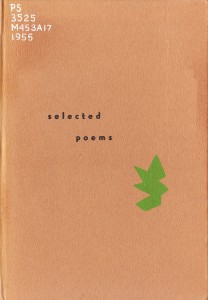
James Boyer May, Selected Poems 1950-1955
(Inferno Press: San Francisco, 1955)

I’m quite mystified by James Boyer May. He’s best known as the editor of Trace, a small press journal that reviewed and charted the progress of small press journals worldwide. A chapter of the book Mavericks: Nine Independent Publishers is devoted to him (along with the likes of James McLaughlin and John Martin), though I haven’t read it yet.

The idiom in these poems is unlike anything I’ve come across in American poetry, though it does have a strange resemblance to certain British poets such as those associated with “Cambridge” writing — a high tone that is open to vulgarities, a careful, tradition-wary metrical precision, a moral earnestness, a syntactic and lexicographical density, even a tendency toward Hopkins-esque word-clusters — though May was born and raised in Los Angeles. “Incredibly, ideals of bomb-feared noons — / here, violent blooms should scintillate, / men supplicate annihilative plans.” (from “Ossia”).

May, due to his connection with Villiers (see above), helped Ginsberg publish the first edition of Howl in the UK, which in turn led to the books being confiscated in mail on the way back.

thomas_cover

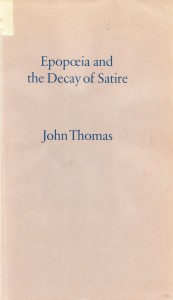
John Thomas, Epopoeia and The Decay of Satire
(The Red Hill Press: Los Angeles & Fairfax, 1976)

Now here’s a difficult case: an undeniably excellent poet who died in prison, serving a sentence for having molested his daughter; a poet whose early work seems to show a visionary breadth and bounding imagination, but who barely published any new poems (or republished, times over, older poems) during the latter part of his life; and a poet Charles Bukowski called “the best unread poet in America” whose style synthesized elements of the most opaque of Olson’s Maximus poems or the collage aesthetic of the Tennis Court Oath (but who was also, at times, sexually frank, morally unambiguous in his amorality, and could tell a good story, like a West Venice West Georges Battaille).

Outside of this small group (most of which also appear in his first collection, called John Thomas), Thomas published a chapbook of poems called Nevertheless in 1990, and contributed to the excellent volume Abandoned Latitudes (with Paul Vangelisti and Robert Crosson) in 1983. A good, if not probing, obituary was published in the UK Independent; a much more detailed, and harrowing, account of his personality by his daughter, Gabrielle Idlet, appeared a little later in the LA Weekly.

clinton_cover

Michelle T. Clinton, High Blood /Pressure
(West End Press: Los Angeles, 1986)

I don’t know much about Michelle T. Clinton — there’s almost nothing on the internet about her — except that she doesn’t live in Los Angeles anymore, and that she has a second volume of poetry, Good Sense & The Faithless, also from West End Press (1994). She’s also recorded a spoken word cassette called “Black Angeles” (1988) with Wanda Coleman, who writes that Clinton’s poems are “exorcisms — the rootings out of racism and sexism.”

I thought of her as a sort of female Etheridge Knight at first, as some of the poems reminded me of Knight’s “Hard Rock Returns To Prison From The Hospital For The Criminal Insane,” with its anecdotal focus on the most hidden parts of society, occasional use of Black English, and somewhat nihilistic underlying philosophy. But Clinton’s poetry is far more interesting — less “literary” (following through on that distrust of the “literary” that runs through much of Los Angeles poetry) though formally quite precise and refined. These poems, unsettling as they can be (and funny also) are packed with an amazing energy, frankness and skill, not to mention searing anger.

honey_cover

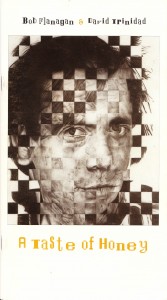
Bob Flanagan and David Trinidad, A Taste of Honey
(Cold Calm Press: Los Angeles, 1990)

Bob Flanagan is best known as a performance artist, cystic fibrosis sufferer, and subject of the documentary Sick: The Life & Death of Bob Flanagan, Supermasochist (view his Super Cystic Fibrosis Song for a taste of that). David Trinidad is best known as David Trinidad, well-known New York poet. But in their younger years they were hanging out at Beyond Baroque with Dennis Cooper, Amy Gerstler and the teenaged Kim Rosenfield and publishing with Cooper’s press Little Caesar (follow the link for full issues).

This is a really enjoyable little volume — 12 poems of 36 lines each, and in iambic pentameter! It has some of the crazed feel of the Berrigan/Padgett collaborations but with a distinctly LA setting. The formal constraint gets you trying to read the poems as monologues (in the manner of, say, Browning), and brings them to a level that Flanagan, in his short, difficult life, was able to achieve in his solo poems (but more on that later).

The cover image, a combined portrait of the two authors, looks a little to me like David Carradine.

reading-747268

CREDIT Launch! & Conceptual Lit Reading! in Los Angeles!
Outpost for Contemporary Art
presented by General Projects, Blanc Press and Insert Press
Saturday December 19, 2009 from 5 p.m. to 8 p.m.
1268 N. Ave 50, Los Angeles, CA 90042 (323) 982-9461

Do you sometimes wonder: “What the heck is Conceptual Writing!?” Some amazing new fad sweeping the nation? Some bland thing a bunch of dudes thought up in a bar as a joke? The new genre of infomercials after the tragic death of Ron Popeil? All this and so much more?!!

After a string of conferences, events, publications, etc–Conceptual Poetry and its Others conference at University of Arizona Poetry Center, May 29-31, 2008; Flarf vs. Conceptual Writing! at The Whitney, April 17, 2009; Conceptual Writing! & Its Environs, The Uferhallen, Berlin, May 1, 2009; a portfolio of Flarf and Conceptual Writing! in Poetry Magazine, July/August, 2009–Conceptual Writing! has arrived in LA, only to find that it’s already there!? Los Angeles!? Conceptual Writing!

Discover Conceptual Writing! and so much more as you encounter the Conceptual Writing! of Harold Abramowitz, Joseph Mosconi, Bruna Mori, Vanessa Place, Ara Shirinyan, Brian Kim Stefans, Mathew Timmons and Christine Wertheim at the Conceptual Lit Reading! & CREDIT Launch! in Los Angeles! at Outpost for Contemporary Art in Highland Park on Saturday December 19, 2009 from 5 p.m. to 8 p.m. presented by General Projects, Blanc Press and Insert Press.

Come celebrate the release of Mathew Timmons’ CREDIT, an 800 page, large format, full color, hardbound book published by Blanc Press and retailing for $199.99 which the author himself lacks the cash or credit to purchase. Come also to celebrate Conceptual Writing! in Los Angeles! with the wonderful Conceptual Writing! of Harold Abramowitz, Joseph Mosconi, Bruna Mori, Vanessa Place, Ara Shirinyan, Brian Kim Stefans, Mathew Timmons and Christine Wertheim at the CREDIT Launch! & Conceptual Lit Reading! in Los Angeles! at Outpost for Contemporary Art in Highland Park on Saturday December 19, 2009 from 5 p.m. to 8 p.m. presented by General Projects, Blanc Press and Insert Press.

For more information about this event, please contact: laliterature [at[ gmail [dot[ com

Information About the Artists

9780982264515

You’re invited to a publication party for
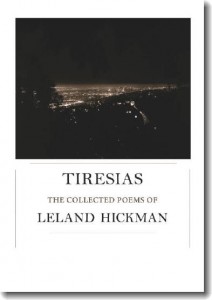
Tiresias: The Collected Poems of Leland Hickman
published by Nightboat Books & Otis Books/Seismicity Editions

with brief readings by Bill Mohr, Stephen Motika & Martha Ronk

Saturday, December 12, 5-7pm
Arundel Books
8380 Beverly Blvd, 3 blocks east of La Cienega Bl.
Phone: 323-852-9852

Los Angeles poet and editor LELAND HICKMAN (1934-1991) was the author of two collections of poetry: Great Slave Lake Suite (1980), which was a finalist for the Los Angeles Times Book Award, and Lee Sr. Falls to the Floor (1991). He was the editor of the poetry journal Temblor, which ran for 10 issues during the 1980s. This new volume collects all of the poems published during Hickman’s life as well as previously unpublished pieces. The volume, edited by Stephen Motika, features a preface by Dennis Phillips and an afterword by Bill Mohr.

Just posted video that I shot of Aaron Kunin’s excellent reading at the Poetic Research Bureau on Nov. 1.

http://www.youtube.com/watch?v=GUweaR79z58

lindseyboldt

john-sakkis

Sunday, November 22, 2009 at 4:00pm

@ The Poetic Research Bureau
3706 San Fernando Blvd
Glendale, CA 91206

Doors open at 4:00pm
Reading starts at 4:30pm

$5 donation requested

Lindsey Boldt lives in San Francisco where she is a practicing poetess, cultural worker, vaudeville-style entertainer, elementary after-school teacher, human jukebox and assistant editor with The Post-Apollo Press. She is the author of the chapbook Oh My, Hell Yes and is currently working on two prose projects related to two very dated 80’s movies.

John Sakkis‘s first full length book, Rude Girl, is just out from BlazeVox Books. He is the author of numerous chapbooks including most recently: Gary Gygax, The Moveable Ones and Rude Girl. With Angelos Sakkis he translates the work of Athenian multimedia artist/ poet Demosthenes Agrafiotis; their translation of Agrafiotis’s Maribor is forthcoming from The Post-Apollo Press as well as Chinese Notebook forthcoming from Ugly Duckling Presse. Recent work has appeared in Area Sneaks, Action, Yes and Octopus. He lives in the Lower Haight and works at Small Press Distribution in Berkeley.

This is the first paid advertisement for Free Space Comix: The Blog. Of course, I’m not being paid for it; Matthew will just owe me. Virtual capital!
credit

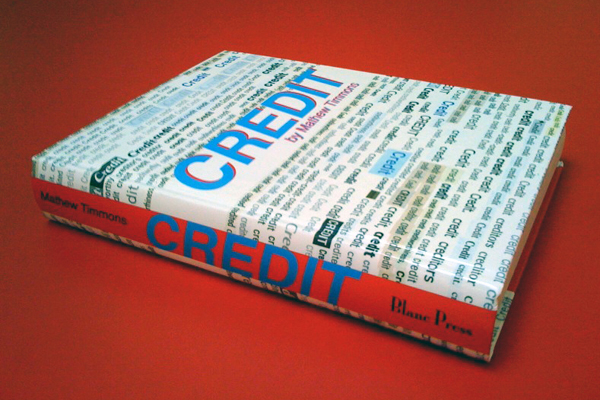
CREDIT by Mathew Timmons
Just Released from Blanc Press in Los Angeles!

CREDIT by Mathew Timmons
Hardcover, 800 pages, full color
Blanc Press, September 2009
ISBN-13: 978-0-9814623-4-9
Dimensions: 11 × 8.5 × 1.75 inches
Price (w/o shipping): $199.99
Download price: $299.99

BUY CREDIT!

CREDIT is an 800 page, large format, full color, hardbound book, available for $199.99 from Blanc Press in Los Angeles–the longest, most expensive book publishable through the online service, lulu.com. Divided into two sections, Part A: Credit–26 parts (a-z) and Part 2: Debit–10 parts (1-10), CREDIT is a highly revealing and emotional work chronicling a personal tale of credit.

In late spring 2007 as an irrational exuberance and promise of financial fortune hung in the air, mailboxes were filled with generous and gracefully worded offers of credit. Just over two years later, in midsummer 2009, the shape of the financial environment changed radically and mailboxes still filled up with statements of credit. Something had to change, offer turned to obligation.

Retailing for $199.99, CREDIT is a book the author himself lacks the cash or credit to buy.

BUY CREDIT!

Mathew Timmons’ CREDIT has been roundly praised by a number of artists, writers, editors and critics, including:
Harold Abramowitz, Stan Apps, Marcus Civin, Brian Joseph Davis, Ryan Daley, Craig Dworkin, Brad Fliss, Lawrence Giffin, James Hoff, Maximus Kim, Matthew Klane, Janne Larsen, Matthias Merkel Hess, William Moor, Joseph Mosconi, Holly Myers, Sawako Nakayasu, Sianne Ngai, Ariel Pink, Vanessa Place, Dan Richert, Ronald Quinn Rudlong Jr., Ara Shirinyan, Danny Snelson, Erika Staiti, Brian Kim Stefans, Robert Summers, Rodrigo Toscano, Matias Viegener and Steven Zultanski.

Read Advance Praise for Mathew Timmons’ CREDIT.

View Images from Mathew Timmons’ CREDIT.

BUY CREDIT!

Read Advance Praise for Mathew Timmons’ CREDIT:
Let’s face it, only those who see the invisible can do the impossible. However, miraculously, and right on cue, just short of a decade into the 21st century, Mathew Timmons has given us a momentous, lucid, and gripping book that makes visible what used to be, exclusively, invisible, the wide terrain of credit. Buy “ CREDIT,” tell your friends to buy it, and take its lessons to heart: Credit is expensive!… Credit is not cheap… Credit is hard, not easy, to get…
—Harold Abramowitz

If you want to pay a penny for a thought Mathew Timmons has 19,999 of them, but like Master Card suggests, Timmons keeps it simple. CREDIT is a work ripped from both the headlines and the mailbox.
—Brian Joseph Davis

I will send a very special, one-of-a-kind, only-available-via-purchase-and-full-completion and proof-of-reading-of-this-book, to all who purchase and read this book. Offer not valid in Kentucky.
—Sawako Nakayasu

CREDIT by Mathew Timmons captures the entire postmodern economy under one cover. Like an avalanche of fine print, CREDIT reveals absolutely everything required to be disclosed by law. Timmons aestheticizes the angst of indebtedness into a colorful durational novel, complete with a lifetime supply of rate, fee, and grace period information, plus all the “__ _ !lI” •••••••• •••••••• & •• ‘.”~.’lf ’ CIa … “ of modern life. This is a book “that do_es lL all for you” and best of all “_.s:ard ~ith _no annu~lJee.”
—Stan Apps

Mathew Timmons’ CREDIT: Approved.
—Sianne Ngai

The output is a sprawling, modular form-letter with all the personal/financial affirmation cut down through razorbladed erasure-transcoding. CREDIT’s procedure traces an unfollowable map from the macrodistortion of mass-market advertising onslaught to a subjective microdistortion of noise stream granulation and reassembly. CREDIT is problematic in terms of numbers, transaction, hardware and software. The text’s operation is ravenously lossy, feeding on filtering byproducts and mistranslation; emphasis on information loss/breakage makes the text self-genotoxic and it sprouts mutant poetry from attractive shapes and corners. The text can be rotated. CREDIT is unreadable and CREDIT is a vibrant autobiography and CREDIT is a rainbow dream.
—Dan Richert

What kind of Art would Human this kind of Receipt?
What kind of Receipt would Art this kind of Human?
What kind of Human would Receipt this kind of Art?
What kind of Art would Receipt this kind of Human?
What kind of Receipt would Human this kind of Art?
Fuckers.
—Rodrigo Toscano

Quite possibly the oldest system of exchange, credit is almost inseparable from wealth. Credit is the laxative to the stubborn bulk of capital. Similarly, how easy can form be separated from content? Or is content itself a kind of para-form? Paraformaldehyde, even? Disinfectant indicating content’s historicity in its obliteration? Content is form not yet recognized as such. Content is form on credit. And it is to Timmons’ credit that he seems to be particularly susceptible to this confusion, bombarded as he seems to be with offers. And though credit and wealth may be interchangeable to the point of identity, still Timmons is all the more duped for believing so.
—Lawrence Giffin

Not since “The Tzanck Check” has a work so conscioned the infra-thin of capitalism—a tour de fort-da.
—Vanessa Place

This work could have easily been called “Labor”—like “Credit,” one of the least understood, least visible of our foundational abstractions. (“Milk” might be the other.) Mathew Timmons has managed to squeeze a Dummy’s Guide of both into a mere 800 pages. Sure, this is art in the age of digital reproduction, but you’re not getting anywhere near this thing.
—Brian Kim Stefans

It seems only natural that with this book I re-appropriate a blurb about another book (Fiona Banner’s The Nam):
“It has been described as unreadable.”
—James Hoff

Congratulations! You’ve been preselected to apply for a copy of the new book by Mathew Timmons at a low introductory rate of just 199.99 and no annual fee ever. Documenting the social and economic space defined by the writing that falls between bulk mailing and fine print (full color and some of it very fine indeed), CREDIT appropriates direct mail credit card solicitations and advertisements in order to explore the nature of disclosure in a series of plays between display and censorship, see-thru windows and security envelopes, financial promise and legal threat—or simply, in Guy Debord’s terms, between monologue and true communication.
Testing the limits of publishing—CREDIT is the largest and most expensive book publishable via Lulu—Timmons’ book is well beyond most readers’ means. But remember, you could always charge it and hope to juggle some good balance transfers down the road…. Respond Immediately and Request Your Copy Today.
—Craig Dworkin

Rarely has the mind-numbing banality of consumer capitalism’s fine-print underbelly been employed to such elegant effect. Mathew Timmons’ CREDIT is a timely epic in this crumbling age of debt.
—Holly Myers

You know Timmons is just saying what Patti Smith said thirty years ago, although he’s saying it even more: “And when we dream it, when we dream it, when we dream it, / Lets dream it, we’ll dream it for free, free money, / Free money, free money, free money, / Free money, free money, free money, / Free money, free money, free money, / Free money, free money, free money, / Free money, free money, free money, / Free money, free money, free money, / Free money, free money, free money, / Free money, free money, free money, free.”
—Matias Viegener
I’ll be in Minneapolis for the next three days. I’m doing a reading and presentation at the Walker Art Center with Oni Buchanan on Thursday:

http://calendar.walkerart.org/event.wac?id=5328&hp=link&poster=Lectures

Thursday, November 12, 2009
Time: 7:00 pm
Location: Cinema
Free tickets available at the Bazinet Garden Lobby

Like everything else in our world, poetry has gone digital, yielding fresh approaches and new insights (and even some controversy) to an ancient art form. Buchanan and Stefans present their latest hypermedia works on screen and in person, and take questions about the past, present, and future of digital poetry. Buchanan is the author of two poetry volumes, What Animal and Spring, and a conservatory-trained concert pianist who performs frequently around the country. Stefans founded arras.net, a website devoted to new media poetry and poetics, in 1998; he also teaches at UCLA and has written numerous books of poetry and essays.

A sequel to my last offering of terrible poetry jokes, which was itself a response to a series of terrible poetry jokes written by Peter LaVelle for the McSweeney’s site.

This might be a bit more in-jokey for the casual reader, but… so there.

***

Charles Bernstein walks into a bar, but with this difference: to bring him to his senses.

Kurt Schwitters, Jaap Blonk and Christian Bok walk into a kwiiee kwiiee. (They each order a “rinnzekete bee bee nnz krr müü!”)

Vito Acconci follows a person he doesn’t know for two hours to a bar. Acconci doesn’t enter the bar. He enters the basement, where he proceeds to masturbate for eight hours.

Paul Lawrence Dunbar walks into a “Whites only” bar and has a few drinks. Then he goes to a “Blacks only” bar and has a few drinks.

***

K. Silem Mohammed walks into a Flarf bar and has sex with a plastic donut — covered in vomit!

Anselm and Eddie Berrigan walk into a Mom and Pop Bar.

Samuel Taylor Coleridge finds in his Hershey’s kiss a “lifetime supply of opium” gift certificate for the new opium bar, “Sicilian Leaves,” that recently opened down the street, so he throws a few things into an overnight bag, combs his eyebrows, drops a bag of Meow Mix into the bowl, and runs down to the bar to begin claiming his prize. He enters, sits down, rubs his hands together, howls “Whoop-eee!,” picks up the opium pipe, and just as he is about to take his first massive toke… there is a knock at the door. He wakes up.

Ted Hughes walks into a crow bar.

***

Marianne Moore walks into a bar and has sex with a mollusk.

Morrissey walks into a bar and has sex with nobody, actually. (He’s too shy.)

Joshua Clover walks into a bar and has sex with Guy Debord.

***

Raymond Roussel walks into a bar. He is immediately arrested for not paying his tab. His sentence: to take over for the head chef, Fung Lee, who has run off with all of the Chinese cookware. Luckily, the San Diego State Marching Band is in the bar, celebrating a recent victory over UCLA, and are imperiously drunk. Raymond Roussel woks in a tuba.

***

Brian Kim Stefans walks into a bar in Los Angeles and orders a Manhattan.

I’ve been recently going to town on Facebook with a slew of oh-so-clever terrible poetry jokes. The whole thing was inspired by a page on McSweeney’s Internet Tendency of terrible poetry jokes, which I’m hoping you’ll read before reading my own contributions, so you get a sense of the, uh, genre. Thanks to Lysette Simmons for turning me on to this. Feel free to add to the list.

They are broken into sets, for whatever reason (because I’m a poet)?

***

Arthur Rimbaud and Thomas Chatterton walk into a bar. They are carded.

***

Sylvia Plath walks into a bar. The bartender says,”What’s cookin’, good lookin'”?

Alfred Tennyson crosses a bar. He is never seen again.

Gertrude Stein walks into a bar, thinking it was a bar. But it was a bar.

***

James Wright walks into a bar. Suddenly, he gets gin blossoms.

Frank O’Hara walks into a bar at 6:27, three day after Columbus Day. (Fifteen years later, Ted Berrigan walks into the same bar, on the same day, at the same time. He orders a Pepsi.)

Sappho walks into a Lesbian bar. Meanwhile, Edward Kamau Brathwaite walks into a Caribbean bar.

***

Allen Ginsberg walks into a bar after the kitchen’s closed. He says, “I’ve seen the best minds of my generation destroyed by starving.” He then goes nuts and strips.

***

Robert Creeley walks into a bar and punches out Willem De Kooning. Then he gets side-swiped by Willem De Kooning.

Carl Sandburg walks into a bar. He stays for a few hours, then leaves. He is immediately forgotten.

Ezra Pound walks into a bar and tries to start a tab with his credit card, but the card is declined: “CONTRA NATURAM.”

D.H. Lawrence walks into a bar and has sex with his mother.

***

Robert Frost walks into a bar. He says: “Fuck this motherfucking place!” The bartender asks: “What’s got into you?” Frost says: “Something that doesn’t love a bar.”

***

Edgar Allen Poe walks into a bar. He orders a vodka tonic. The bartender asks: “What kind of vodka?” The raven on Poe’s shoulder says: “Stoli.”

Because the bar would not stop for Emily Dickinson, they stopped serving her. (Turns out, she’d never left her bedroom.)

William Blake walks into a bar and has sex with Eternity.

***

William Butler Yeats walks into a bar that is advertising a happy hour with 100% off on all drinks. He orders a vodka tonic. The bartender says: “That will be two dollars.” Yeats says: “Innisfree”?

***

Jim Morrison walks into a bar. The bartender says: “You’re not a poet!?”

Kenneth Goldsmith walks into a bar. He orders a menu.

Ron Silliman walks into a bar. Shadow of palm tree on fading Exxon sign (employees standing under it). We park the car: the carp of parse. Capitalism.

***

John Ashbery walks into a bar. The bartender says: “What’ll you have?” Ashbery says: “Some drinks.”

William Carlos Williams and T.S. Eliot walk into a bar. Williams says: “I’ll have a Red Wheelbarrow!” Eliot says: “Jew!”

e.e. cummings walks into a bar. l(one) line (s)(s).

*

Gwendolyn Brooks walks into a bar, because black women poets are under-represented on this list.

More Terrible Poetry Jokes from this blog.

For fans of Ryan Trecartin, this clip from the Japanese “horror” flick Hausu is just too good. More videos of this director, Nobuhiko Obayashi, can be found on ubu.com.

This just in from the PRB…

Mark Author Photo B&W

We know it’s hard sometimes to get across the city in the evening, but if you are at all interested in the intersection of poetry and documentary, or literature and political practice, you shouldn’t miss a rare visit from Mark Nowak.

Mark is the founding editor of the journal XCP: Cross Cultural Poetics, and will be reading from his new book, a transnational photo-documentary collaboration with UK/Chinese photojournalist Ian Teh. He’ll also be showing some video of his workshops with Ford autoworkers at plants in the US and South Africa.

***

The Poetic Research Bureau presents….

Mark Nowak

Thursday, November 5, 2009 @ 8:00pm

Doors open at 8:00pm
Reading starts at 8:30pm

$5 donation requested

@ The Poetic Research Bureau
3706 San Fernando Blvd
Glendale, CA 91206

Mark Nowak is a poet, social critic, labor activist, and author of, among others, Coal Mountain Elementary and Shut Up Shut Down, a New York Times “Editor’s Choice.” His work has also been included in Goth: Undead Subculture and American Poets in the 21st Century: the New Poetics. Nowak is “regenerating the rich tradition of working-class literature,” encouraging students to engage in all forms of poetry and expression, not just those found in mainstream literature and art. He is also the editor of the journal, XCP: Cross Cultural Poetics.

I highly recommend this… and if you’re in Vancouver or Seattle, go to the launches later this month!

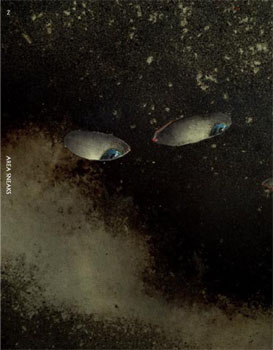
COVER.indd

Announcing AREA SNEAKS #2

Benevolent area-sneaks get lost in the kitchens and are found to impede the circulation of the knife-cleaning machine.
– Charles Dickens

Area Sneaks is a Los Angeles-based journal edited by Joseph Mosconi & Rita Gonzalez that seeks to encourage dialogue between the worlds of visual art and poetry.

*interviews with VISUAL ARTISTS*
Edgar Arceneaux interviewed by Noellie Roussel
Analia Saban interviewed by Claire de Dobay Rifelj

*POETRY by*
Elisa Gabbert & Kathleen Rooney
Aaron Kunin
Doug Nufer
Franklin Bruno
Demosthenes Agrafiotis
Ara Shirinyan
Harold Abramowitz & Amanda Ackerman
Mathew Timmons
Will Alexander
Richard Kostelanetz

*portfolios of VISUAL ARTISTS*
Jody Zellen
Demosthenes Agrafiotis

*a VISUAL POETRY symposium featuring*
Robert Grenier
Johanna Drucker
Peter Ciccariello
Jessica Smith
William R. Howe
Derek Beaulieu
conducted by K. Lorraine Graham

*ARTIST-POET collaborations*
Kerry Tribe & Nick Moudry
Hillary Mushkin & Jen Hofer

$15
AVAILABLE ON-LINE via Paypal
or
email info@areasneaks.com for other arrangements

**
Upcoming Launch Events

Seattle: Friday, November 6, 7:30pm at Pilot Books, 219 Broadway E, Seattle, WA

Vancouver: Saturday, November 7, 8:00pm at Artspeak, 223 Carrall Street, V6B 2J2 Canada, Vancouver, BC…hosted by the Fillip Review

http://areasneaks.com

greenstreet

AaronK

Sunday, November 1, 2009 at 4:00pm

@ The Poetic Research Bureau
3706 San Fernando Blvd
Glendale, CA 91206

Doors open at 4:00pm
Reading starts at 4:30pm

$5 donation requested

Kate Greenstreet‘s second book, The Last 4 Things, is new from Ahsahta Press and includes a DVD containing two short films based on the two sections of the book. Ahsahta published Greenstreet’s case sensitive in 2006. She is also the author of three chapbooks, most recently This is why I hurt you (Lame House Press, 2008). Find her poems in current or forthcoming issues of jubilat, VOLT, the Denver Quarterly, Fence, Court Green, and other journals. Visit her online at kickingwind.com.

Aaron Kunin is the author of a book of poems, Folding Ruler Star, and a novel, The Mandarin. Another collection, The Sore Throat and Other Poems, is forthcoming. He will be reading from a new chapbook, Cold Genius. He lives in Los Angeles.

« Previous PageNext Page »