Friday Oct 30, 7pm
@ 5941 Maccall St (@ 60th St)
North Oakland
near Ashby BART
please BYOB
costumes encouraged…

*Area Sneaks* is a Los Angeles-based journal edited by Joseph Mosconi and Rita Gonzalez which seeks to encourage dialogue between the worlds of visual art and poetry.

The Bay Area launch of Area Sneaks 2 will include:

A video presentation by artist Hillary Mushkin
A screening of Marie Jager’s short film *The Purple Cloud*
Readings by Therese Bachand, Mathew Timmons & Ara Shirinyan
Poetry by Demosthenes Agrafiotis read (and translated) by John Sakkis

…and possibly even more surprises!

The second issue features interviews with artists Edgar Arceneaux and Analia Saban; portfolios by artists Jody Zellen and Demosthenes Agrafiotis; a forum on Visual Poetry conducted by K. Lorraine Graham that includes contributions by Robert Grenier, Johanna Drucker, Peter Ciccariello, Jessica Smith, William R. Howe and Derek Beaulieu; poetry by Aaron Kunin, Elissa Gabbert, Kathleen Rooney, Will Alexander, Richard Kostelanetz, Ara Shirinyan, Mathew Timmons, Doug Nufer, Franklin Bruno, Harold Abramowitz and Amanda Ackerman; and artist-poet collaborations between Jen Hofer & Hillary Mushkin as well as Nick Moudry & Kerry Tribe.

http://www.areasneaks.com

I just bought my ticket to this… yes, it means I’ll be missing the PRB reading, which I was looking forward to, but this is a rare appearance in LA of the filmmaker, and I missed his show at Redcat earlier this week.

motherlove

Thursday October 15 2009, 7:30PM
KEN JACOBS IN PERSON – New films!
UCLA Film & Television Archive
at the Billy Wilder Theater at the Hammer Museum

http://www.cinema.ucla.edu/public/calendar/calendar_f.html

“A stereo-photo of an ocean wave slowly turns and churns. The hidden forces of Cinema conspire with an instant of history to produce actions that never were or could be. 3D for everyone (one eye will do).”—Ken Jacobs

One of the key American media artists of the postwar era, Ken Jacobs (Tom, Tom, The Piper’s Son; Star Spangled to Death) has crafted a unique, powerful and ever-evolving body of work over a career that has spanned five decades. Appropriating and reinterpreting existing media artifacts, and subverting conventional modes of presentation, Jacobs has applied his highly original techniques to both formal considerations and social and political topics with equal aplomb.

This program showcases some of Jacobs’ most recent work, much of which creates new forms of three-dimensional depth, and is presented as part of a week-long artist residency in Los Angeles, in cooperation with REDCAT, Los Angeles Filmforum, and CalArts Film/Video.

A SCORCHER IN ITALY (2009, DVcam, Color, silent, 7 min.)

WHAT HAPPENED ON 23RD STREET IN 1901 (2009, DVcam, silent, B/W, 14 min.)

JONAS MEKAS IN KODACHROME DAYS (2009, DVcam, silent, color, 3 min.)

BOB FLEISCHNER DYING (2009, DVcam, silent, color, 3 min.)

HOT DOGS AT THE MET (2009, DVcam, color, 10 min.)

EXCERPT FROM THE SKY SOCIALIST STRAIFIED (2009, DVcam, silent, color, 18 min.)

GRAVITY IS TOPS (2009, 10 min.)

BRAIN OPERATIONS (2009, DVcam, silent, B/W, 22 min.)

Thursday, October 15th at 8:00pm
C.J. Martin, Julia Drescher & Michelle Detorie

Doors open at 8:00pm
Reading starts at 8:30pm

This reading will be hosted by our special guest, Harold Abramowitz. C.J. and Julia are from the Lone Star State and edit Dos Press. Michelle is from Goleta and edits Hex Presse.

***

Sunday, October 18 at 3:00pm
“Things & Ideas”: Martha Ronk & Andrew Maxwell

Doors open at 3:00pm
Reading starts at 3:30pm

Martha Ronk and Andrew Maxwell play the old modernist saw and tip back that sweet Tennessean jar for a weekend reading on classic ontological themes. Hypostatizers unite as Martha reads from her new collection about things, and Andrew reads from a few new chapbooks about ideas. Ponge would be piqued!

***

C.J. Martin lives in Lockhart, TX, where he co-edits Dos Press with Julia Drescher. He’s also a contributing editor for Little Red Leaves (www.littleredleaves.com) & LRL e-editions. 3 chapbooks: _WIW?3: Hold me tight. Make me happy_ (Delete Press, 2009), _Lo, Bittern_ (Atticus/Finch, 2008) and _CITY_ (Vigilance Society, 2007). Work recent and forthcoming in Antennae, Broke (w/Julia Drescher), try! (w/Julia Drescher), Coconut, Colorado Review, Denver Quarterly, P-Queue, kadar koli, American Letters & Commentary, The Argotist Online, zafusy, the tiny, & Damn the Caesars.

Julia Drescher‘s poems may be found in Dusie, Broke, Try, The Colorado Review, P-Queue, goodfoot, & the tiny. A chapbook, Book of Hilda’s Hunting, was recently published as part of the Dusie Kollectiv. She co-edits Dos Press (with C.J. Martin) & the online poetry journal Little Red Leaves.

Michelle Detorie lives in Goleta, CA where she edits WOMB and Hex Presse. She is the author of the poetry chapbooks Daphnomancy, Bellum Letters, A Coincidence of Wants, and Ode to Industry, the picture-poem series Psychedelic Domestic and Die*o*rama, and the pamphlet How Hate got Hand. She is currently working on a series of synesthetically coded visual poems that investigate the question of women and animals and whether or not they are real.

Martha Ronk is the author of eight books of poetry, most recently Vertigo, a National Poetry Series selection published by Coffee House 2008, and In a landscape of having to repeat, a PEN USA best poetry book winner 2005, Omnidawn Press. Her fiction, Glass Grapes and other stories was published by BOA Editions 2008. She is a 2007 NEA recipient and has had residencies at both Djerassi and MacDowell. She teaches both creative writing and Renaissance literature at Occidental College, Los Angeles.

Andrew Maxwell is co-director of the Poetic Research Bureau. He edited the occasional poetry journal The Germ, directed the Poetic Research reading series out of Dawson’s Bookstore in central LA, and was a founding member of the online French-American translation collective Double Change. His aphorisms, poems, essays and translations have appeared in several American and French magazines including Jubilat, Fence, Triple Canopy, The Hat, Area Sneaks, Arsenal and Poésie.

@ The Poetic Research Bureau
3706 San Fernando Blvd
Glendale, CA 91206

$5 donation requested

ATTENTION!

THE PRB STOREFRONT HAS MOVED!

Same building, we’ve just moved our operations and bookshelves next door to the Luna Playhouse. Readings still take place in the same theater in which they’ve always taken place.

I’m sure this will be greeted with some consternation by some! But, alas, what can I do. Here is a draft of my course description for an undgraduate class called “American Poetry Since 1945.” It’s one of the standard “on the books” classes here at UCLA, and has been taught in the past, in very different ways, by Cal Bedient, Harryette Mullen, Stephen Yenser and Kenneth Lincoln. (And others, I’m sure.)

I’m really glad they’ve let me take a stab at it. Clearly I’m trying to hit as many bases as I can — it’s a bit overstuffed (none of my predecessors assigned two books a week), but even so, misses a lot of points. Hence the final paragraph, which invites the interested student to pursue their own independent course of study within the context of the class.

One or two “contemporary” poets (whose names I’ll omit) I might have listed had I had any idea at all how to teach them. This isn’t to say that I’ve only included very “teachable” poetry, just that I felt compelled to omit one or two who I don’t think I understand enough to feel qualified to impart any knowledge about, or insight into, how to write about them (since, in the end, the students will be writing papers about one or a group of these poets). I also tended toward poets I thought would be appealing to the young.

I thought it was important to include a section of Los Angeles poets, since I don’t think (as I’ve stated elsewhere on this blog) anyone has any idea of the depth (not to mention strangeness) of the work that is being done, and has been done, out here. UCLA (the campus) feels quite far away from what one could call “Los Angeles” proper (you know, the dirty, urban parts), and of course I would want to encourage any of my young students, especially if they are writers, to think of this city as a place where writing can be done.

So, this is a draft. Many of my adjectives are a little funky (where’s Michael Scharf when you need him?), and there might be some switch-outs of names or titles in the next week or so. But I’ve been thinking about it for a while, and so I think it’s quite solid. I wanted to assign Donald Allen’s anthology along with the Norton but that seemed overkill and they duplicate a lot of material. The “Vintage” anthology is the one edited by J. D. McClatchy.

I’ll probably make a better go of this one than I did “American Poetry Before 1900,” which I taught last year, given my long acquaintance with a lot of these poets, not to mention personal interactions and friendships with many of them. I mean, I did pee next to John Greenleaf Whittier once at the St. Mark’s Poetry Project (1845 or so), but it didn’t help me understand his poetry.

American Poetry Since 1945

The Modernist Period in American poetry was marked by an incredible number of advances in poetics: the polyglot, metrically intricate work of Ezra Pound, the “Cubist,” nearly abstract work of Gertrude Stein, the word-centered “variable foot” of William Carlos Williams, the philosophically nuanced, European-inflected work of Wallace Stevens and T.S. Eliot, the typographical experiments of E.E. Cummings, the complex syllabic stanzas of Marianne Moore and the collective efforts of Harlem Renaissance writers such as Langston Hughes, Jean Toomer and Countee Cullen (along with prose writers such as Zora Neal Hurston) to create a distinctly African American voice in literature. More formally conservative, but no less vital, poets, such as Edwin Arlington Robinson, Robert Frost and the Southern Agrarians (John Crowe Ransom, Allen Tate), were equally active during these years.

This course attempts to provide a map to the large number of important, engaging American poets who started their careers in the period following World War II, during which time many of the above writers were still very active and being accepted into the mainstream, and continues to consider several poets who are at present in mid-career.

The course starts with a consideration of the first major generation of poets to follow the Modernists, usually classed under the title of “Confessional” poets due to their tendency to reveal in their writing aspects of their personal lives that would not have been considered suitable material for poetry mere decades earlier: Robert Lowell, Sylvia Plath and John Berryman. Other important poets writing around this time – most notably Elizabeth Bishop – rarely were so candid in their work, but maintained strong ties with this group. A slightly younger group of writers, such as A.R Ammons, James Merrill and James Wright, will also be considered in these sessions.

The course will then move on to various other groupings of poets – such as the “New York School” (Frank O’Hara, John Ashbery, James Schuyler), Beat Poetry (Allen Ginsberg, Gregory Corso), Projective Verse (Charles Olson , Robert Creeley) and poets associated with the “San Francisco Renaissance” (Robert Duncan, Jack Spicer) – all of whom first reached a wider audience through publication in Donald Allen’s seminal anthology “The New American Poetry” in 1960. These poets generally challenged not only the ways that poetry could be written, but also the types of content – openly non-conformist, sexually “liberated,” anti-academic, at times vulgar and often very funny – that could be included in poetry, setting the stage for what would become the widespread cultural revolution of the Sixties.

The course then moves on to poets in the spirit (though often actively contradicting the tenets) of the New Americans, such as the Language School – writers who sought to synthesize the most recalcitrant strands of Modernism with a Leftist critique of capitalist culture (Charles Bernstein, Bruce Andrews, Lyn Hejinian, etc.) – and poets of color who, inspired both by the Harlem Renaissance and various more revolutionary strands in American culture, sought to create a poetry that disturbed the normality of poetic discourse by including all sorts of elements in the language to signify their (and language’s) “otherness” (Amirki Baraka and other poets of the Black Art Movement, Victor Hernandex Cruz, Jessica Hagedorn, etc.). These poets could, collectively, be called poets of the “Americas,” not acknowledging that there is something called a “standard English” that poetry has to be written in but several different “Americas” existing in (and troubling) the whole.

It is, of course, nearly impossible to give a complete picture of the wilds of American poetry as it is developing today. With this in mind, the last 4 weeks of the course are devoted to 8 younger poets who are in mid-career.

One week will be spent reading two important Canadian poets who have made a huge impact on American poetry in the past decade and a half, the experimental, craftsman-like Christian Bok and the prolific classicist Ann Carson. We will then move to on to look at how lyric poetry is being employed in the philosophically nuanced sonnets of Ben Lerner and the hilarious, subversive serial poetry of CA Conrad. Next, we will look at “conceptual” poetry (poetry of process) as it is practiced, to very different ends, by politically-engaged poet/critic Juliana Spahr and the New York impresario avant-gardist Kenneth Goldsmith. Last , we will read two books by poets from East L.A., the imagistic, often satirical prose poems of Japanese American Sesshu Foster and the visionary surrealist work of the increasingly-esteemed Black poet Will Alexander.

This course is designed so that students – using the two large anthologies that they will be purchasing along with books they can purchase on their own – can trace their own thematic, formal, even geographical lineages, traditions and trajectories through the period covered and to write a final paper on them. Such alternative groupings include feminist poets, gay poets, California poets, visual poets, formal poets, etc. To this end, several “alternative” suggested readings will be provided, though, of course, each student is required to do all of the assigned reading and secondary assignments as well.

00. Introduction: A review of Modernism
01. Vintage Contemporary Poetry – Robert Lowell & “Confessional” Poetry
02. Vintage Contemporary Poetry – Bishop/Ammons/Merrill, etc.
03. Postmodern American Poetry –The Beats & the San Francisco Renaissance
04. Postmodern American Poetry – The New York School & Projective Verse
05. Postmodern American Poetry – Language Poetry
06. Postmodern American Poetry – The “Poetics of the Americas”
07. Two Canadians: Christian Bok & Anne Carson
08. Versions of the Lyric: Ben Lerner & CA Conrad
09. Conceptual Poets: Juliana Spahr & Kenneth Goldsmith
10. Los Angeles Poetry: Sesshu Foster & Will Alexander
This just came in…

Eileen Myles

Join us tonight (Wednesday Oct 7th) at 8pm for Eileen Myles reading the entire text of her essay “Iceland” from her new book (also called Iceland). The performance is expected to last about 90 minutes. Eileen informs us that the audience is not compelled to stay for the whole reading, although you are welcome to if you like. We will have some large green beanbags around if you want to settle in for the duration.

http://machineproject.com/events/2009/10/07/eileen-myles-reading/

A launch party for the new poetry collection by Will Alexander:

Will-Alexander

The Sri Lankan Loxodrome (New Directions Publishing)

Sunday, October 11, 5:00pm

at Skylight Books

FREE

1818 N. Vermont Avenue
Los Angeles, CA 90027
Tel: (323) 660-1175

Will Alexander is a poet, novelist, essayist, playwright, and visual artist who lives in Los Angeles, the city where he was born in 1948. He was the recipient of a Whiting Fellowship for Poetry in 2001 and a California Arts Council Fellowship in 2002. Over the years he has worked several jobs (including the LA Lakers box office), has taught at various institutions, and has been associated with the nonprofit organization Theatre of Hearts/Youth First, working with underserved, at-risk youth.

The Sri Lankan Loxodrome (Paperback)

By Alexander, Will

$14.95

ISBN-13: 9780811218290
Published: New Directions Publishing Corporation, 09/01/2009

One of the more pleasurable discoveries of my late night Youtube parties has been the songs and videos of Nelson Ned.

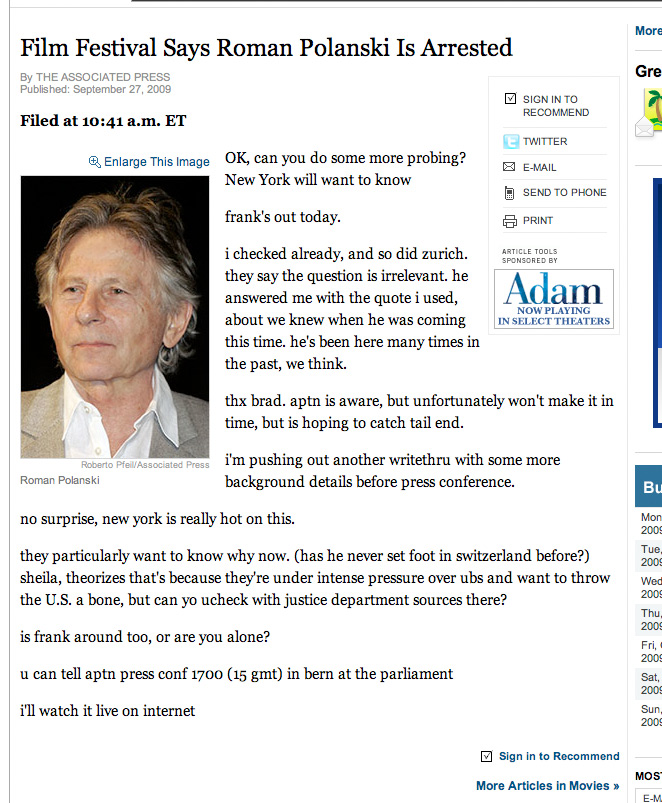
So I click on the story “Film Festival Says Roman Polanski Arrested” this morning on the New York Times website and get the following. (click to enrage)

I like the fact that AP reporters communicate in tweet language, and go to the internet for news. But I guess I knew that already. Curious what series of accidents gets an chat dialogue into the a news item approved for circulation to the New York Times.

Reminds me that my first experience with the “internet” was hanging out with my friend Jay Szep, who was then just starting to work for Reuters, in Toronto some time in the early 90s, and he logging onto the Reuters system and being able to read unpublished or raw news articles and notes from around the world which he could then refine, add on to, use for his stories, etc. Seemed so wild.

I wish this happened more often, would make a good book project.

As some of you know, I’ve been researching the history of poetry in Los Angeles for the past two months or so. I haven’t done much more than take out a bunch of poetry books and anthologies from the library and do some web research, but in fact there isn’t much critical writing about the “history” of L.A. Poetry available. I did find a very useful dissertation by the poet and anthologist Bill Mohr which covers a large portion of this story, but it’s quite rough at the moment (I don’t know if he’ll publish it as a book, but it needs revision).

One book, Venice West, by John Arthur Maynard, was very useful for the Beat Era. And in general, my project was inspired by a wonderful art book called Catalogue L.A.: The Making of an Art Capital 1955-1985, which is a documentary chronology of the birth of the visual art culture out here.

I was hoping to publish capsule biographies of these poets with this initial post, but I think that’s going to take longer than I thought. Some of these poets, like Thomas McGrath, are better known for their work elsewhere, but McGrath was important for his time as organizer, editor, and general cultural force for the ten years he lived in Los Angeles. Like many poets in L.A. at the time, he was called to testify before HUAC and lost his job as a result.

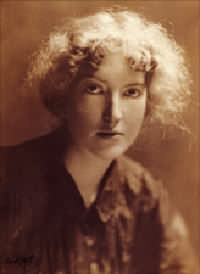
Nora May French (the link is to a website that has several bios and all of her poems) will be a new name to most of you. She moved here at the age of seven, in 1888, when the population was roughly 50,000 people. As if in anticipation of the transformations the city would undergo when the movie industry took over, French was very beautiful and a little imbalanced, finally killing herself by ingesting cyanide (after, I think, trying to kill an ex-lover of hers).

Indeed, many poets in Los Angeles died prematurely (especially among the group who hung around Wallace Berman in Venice, as documented in the beautiful book Semina Culture: Wallace Berman & His Circle), due to heroin, alchohol abuse, suicide and freak accidents. Our most widely-read poet was, of course, a raging alcoholic.

Probably the most famous death of a poet in Los Angeles was that of Bob Flanagan, who suffered from cystic fibrosis, and who documented his long decline (he did, in fact, live much longer than his doctors had predicted) in his book The Pain Journal and in the film SICK: The Life & Death of Bob Flanagan, Supermasochist. It doesn’t appear that he wrote (or at least published) all that many poems, but I’m still looking into this. I’ve found a few chapbooks and anthology appearances. My favorite writing by him is the great collaboration he did with David Trinidad called A Taste of Honey.

Another figure who is not often considered a “poet” but whose work clearly skids over in that direction is the artist Guy de Cointet (born in France). A recent issue of Artforum contained a large tribute to him by artists such as Paul McCarthy and Mike Kelley, much of which can be read online. Most of his writing was of plays or performances (he might be the most representative figure of experimental theater out here, for all I know), but many of his art books are clearly some form of cryptographic poetry. Here are some of the hand-drawn ones in a seemingly Lettrist tradition; most of what I’ve seen in the library has been typeset. (He kind of reminds me of Gaudier-Brzeska in this photograph.)

This list is primarily geared toward “experimental” poets, but of course, such a category is fluid, and I somehow find poets like Nora May French “experimental” to the degree that no one was probably writing poetry in Los Angeles at the time (and she was so weird). As the list moves toward more contemporary figures, it is spotty, as I’m really concerned with poets of the past. But I’m posting this specifically to get some feedback, especially concerning names that I’ve overlooked and possible places I could go to find information about some of the more elusive ones (such as de Cointet, whose books are incredibly expensive and have never been reprinted).

I have yet to go through back issues of Coastlines, Invisible City, etc., but that is next on my agenda. I haven’t gotten my hands on a few anthologies yet, such as Specimen 73, edited by Paul Vangelisti.

Tacked on to the end of this list is a group of writers and artists who I somehow want to claim as Los Angeles poets, either because they lived here for several years (such as Brecht, who can be seen as a sort of analogue for Duchamp in New York, though Brecht really didn’t like it out here for the most part), use a lot of text in their work (such as Ruscha, Pettibon and Ruppersberg, the latter of whom could almost be called a “conceptual writer,” which is useful since much poetry out here now is “conceptual” in nature), or have collaborated with poets and published their own poems, such as Simone Forti, the legendary choreographer.

David Antin, of course, doesn’t live in Los Angeles, but his wife is often considered part of the continuum of the arts up here (at least in Catalogue L.A.), and I can’t help but think his turn toward conceptual performance was influenced by the L.A. art scene. William Poundstone, a digital artist and writer, is kind of the unifiying figure of all the diverse genres represented here, as his work is as influenced by artists like Ruscha as it is by the Oulipo and concrete poetry (as he states in this interview I did with him several years ago).

(Of course, I’d like to claim Morrissey for this list, but that’s really stretching it. But if any of you know of any other Latin American poets who wrote in Los Angeles, let me know!)

Poets
Nora May French (1881-1907)
James Boyer May (1904-1981)
Edwin Rolfe (1909-1954)
Thomas McGrath (1916-1990)
Josephine Ain (1916-2004)
Charles Bukowski (1920-1994)
Henri Coulette (1927-1988)
Bert Meyers (1928-1979)
Robert Crosson (1929-2001)
Stuart Perkoff (1930-1973)
John Thomas (1930-2002)
Jack Hirschman (1933-)
Lewis MacAdams
Leland Hickman (1934-1991)
Guy de Cointet (1934-1983)
Aram Saroyan (1943-)
Paul Vangelisti (1945-)
Wanda Coleman (1946-)
William Poundstone
Will Alexander (1948-)
Douglas Messerli (1946-)
Calvin Bedient
Michelle T. Clinton
Dennis Philips (1951-)
Bob Flanagan (1952-)
Dennis Cooper (1953-)
David Trinidad (1953-)
Harryette Mullen (1953-)
Diane Ward (1956-)
Amy Gerstler (1956-)
Sesshu Foster (1957-)

Figures on the Periphery
Sadakichi Hartmann (1867-1944)
Robinson Jeffers (1887-1962)
Bertolt Brecht (1898-1956)
George Open (1908-1984)
Gil Orlovitz (1918-1973)
David Antin (1932-)
Simone Forti (1935-)
Ed Ruscha (1937-)
Allen Ruppersberg (1944-)
Raymond Pettibon (1957-)

[Not to be missed… here’s the invite I got in the email this morning…]

A Thursday night three-fer for those of you who are mid-week and short of breath.

No shallows here. We’re carting the iron lung into the round, and the machine will speak! From the farflung haunts of London, Mexico City and the village by the Bay, it’s positive pressure units all around. Our cabin is your utopeapod.

Sounding it out: Tom Raworth, Kevin Killian & Gabriela Jauregui.

Thursday, September 24 2009 at 8:00pm

@ The Poetic Research Bureau
3702 San Fernando Blvd
Glendale, CA 91206

Doors open at 8:00pm
Reading starts at 8:30pm

$5 donation requested

Tom Raworth has been writing to amuse himself for half-a-century: the random threads from this hedonism have led him this year to China and the North Eastern Tibetan plateau, now to L.A., and to Mexico in November. In Italy two years ago he was awarded the Antonio Delfini Prize for “lifetime career achievement” though he is not yet dead. His Collected Poems was published in 2003 by Carcanet, who will publish a book of poems since that collection in 2010. His Collected Prose appeared from SALT this year. He has occasionally taught in the UK , the USA and South Africa; and has read his work in more than 20 countries. His graphic work has been exhibited in Europe, the USA and South Africa, and he has collaborated with musicians, painters and other poets. His children, grandchildren and a few friends keep him awake.

Kevin Killian has written two novels, Shy (1989) and Arctic Summer (1997), a book of memoirs, Bedrooms Have Windows (1990), two books of stories, Little Men (1996) and I Cry Like a Baby (2001) and two books of poetry, Argento Series (2001), and Action Kylie (2008). With Lew Ellingham, Killian has written often on the life and work of the American poet Jack Spicer [1925-65] and with Peter Gizzi has edited My Vocabulary Did This To Me: The Collected Poetry of Jack Spicer (2008) for Wesleyan University Press. For the San Francisco Poets Theater Killian has written thirty plays, including Stone Marmalade (1996, with Leslie Scalapino), The American Objectivists (2001, with Brian Kim Stefans), and Often (also 2001, with Barbara Guest). New projects include Screen Tests, an edition of Killian’s film writing, and Impossible Princess, a new fiction collection forthcoming from City Lights Books in November. A new novel Spreadeagle will appear in the spring.

Gabriela Jauregui (b. Mexico City, 1979) is the author of Controlled Decay (Akashic Books/Black Goat Press, 2008). She holds an MFA in Creative Writing from UC Riverside and an MA in Comparative Literature from UC Irvine. Her critical, creative and collaborative work has been published in journals and anthologies in the US, Mexico, and Europe, including, most recently in New American Writing, Eje Central, and forthcoming in Mandorla. She is a member of the sur+ publishing collective in Mexico. Gabriela is a Ph.D. candidate in Comparative Literature at USC and a Soros Fellow. She lives and works in Los Angeles and Mexico City.

Las ideas verdes descoloridas duermen furiosamente.
Las memorias pegajosas oleaginosas asesinan afablamente.
Los salmos obsoletos futuristas discuten curiosamente.
Los platanos cuadriculados amorfos eructan lateralmente.

Los ateos imbeciles virtuosos excomulgan carismáticamente.
Las sandalias huesudas regordetas analizan frontalmente.
Los susurros manipuladores impotentes ensordecen preferentemente.
Los iglúes chinos teutónicos incuban sabiamente.

Los arbustos inefables irritantes escrutinan discretamente.
Los esclavos contratados autocráticos sindican individualmente.
Los logaritmos ágiles artríticos amplifican silenciosamente.
Las ideas verdes descoloridas duermen furiosamente.

(This is a translation into Spanish of my poem “The Slush of Meaning,” a poem premised on the idea of naturalizing the famous sentence of Noam Chomsky’s that he wrote as an example of a sentence syntactically correct but semantically meaningless. I did the initial translation using Babelfish, but it was refined by Román Luján prior to my reading in Mexico City. You can see Román and I read it at Youtube, about two minutes into this clip.)

I’ve just put the video of my reading at La Bota in Mexico City up on Youtube.

It was a long reading, partly because a good number of the poems were read in Spanish (such as the rather long one, “We Make,” which was published in Tierra Adentro in Román Luján’s translation). Other poems read in Spanish by Román include “They’re Putting a New Door In” and “The Slush of Meaning” (which I actually translated myself with the help of Babelfish and Román).

There are forty minutes of it on Youtube, but the video actually doesn’t include the last three or four poems I read because the camera ran out of space. The Youtube also doesn’t have the introduction by Jorge Betanzos, most of which wasn’t recorded, but I’m going to put what part of it there is online soon.

Some really nice ambient noise in this recording. La Bota is the same restaurant where the paella party featured in my Facebook photo album took place. Good times.

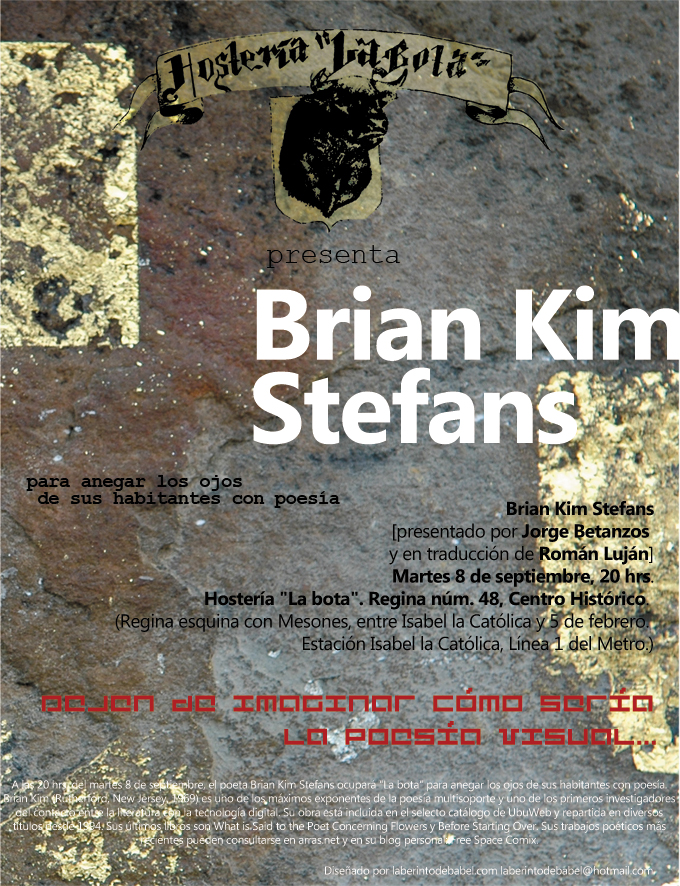
Well, this already happened, but for the record, there was a nice poster made for my reading at La Bota, which is the same place where the famous paella party happened in my Facebook photo album (no pics of the reading up yet). Thanks to all who attended!

I hope David doesn’t mind that I’m posting this to my blog. These are nice events in his backyard, and I don’t expect a torrent of interest from my very few blog readers!

***

Please welcome a good friend and fine poet from Ireland, Maurice Scully, who is visiting California for the first time this month.

Maurice Scully and Brian Kim Stefans will read in the back yard of my home in Silver Lake (address below) at 5.00 pm, Sunday, September 20, 2009. Light foods and drinks, alcoholic and not, will be served.

Maurice Scully was born in Dublin in 1952 and spent his childhood between Clare, the Irish-speaking Ring Gaeltacht and Dublin. He was educated at Trinity College, Dublin, after which he spent some restless decades between Ireland, Italy, Greece and Africa. In a writing career that began in the early ‘70s he has published over a dozen volumes of poetry and taken part in conferences and festivals in the UK & US where his readings are prized as key interpretations of his complex, engaging work. The selection in this volume, made by the poet himself, draws on the extensive ‘Things That Happen’ project (1981—2006), as well as three new books, Several Dances, Humming and Work. A sample of Maurice’s work is at Wild Honey Press: http://www.wildhoneypress.com/BOOKS/livelihood.htm and http://www.wildhoneypress.com/Audio/AUDIOLIST.html

Brian Kim Stefans has published several books of poetry including Free Space Comix (Roof Books, 1998), Gulf (Object Editions, 1998, downloadable at ubu.com) and Angry Penguins (Harry Tankoos, 2000), along with several chapbooks, most recently “What Does It Matter?” (Barque Press). Fashionable Noise: On Digital Poetics, a collection of essays, poetry and interviews, appeared in 2003 from Atelos. His newest books are What Is Said to the Poet Concerning Flowers (Factory School, 2006), collecting over six years of poetry, and Before Starting Over: Selected Writings and Interviews 1994-2005 (Salt, 2006). He is the editor of the /ubu (”slash ubu”) series of e-books at www.ubu.com/ubu and the creator of arras.net, devoted to new media poetry and poetics, where most of his work, including his own series of Arras e-books, can be found.

3020 Effie Street
Los Angeles
CA 90026

I’m teaching this graduate seminar at UCLA this coming quarter and decided to post the description to my blog since graduate students from other schools in (and outside of, I think) the UC system can take the course if they’d like. I haven’t put together a website yet but the book list is set.

We already have students from a wide variety of backgrounds, and I’m encouraging students to pursue lines of research peculiar to their concentration. We might have guest visits from a few of the artists we will be covering, and I’m hoping the class can form a basis for more cross-departmental collaborations with Design/Media Arts and Information Systems (where Johanna Drucker has recently been hired), as well as with people working in the poetry and arts community at large in Los Angeles (and next, the world… after Berlin, of course).

Drop me an email if you have any questions.

English 257 Poetry in the Age of New Media

“Poetry,” for the purposes of this course, stands for two things: the “poems” themselves, and the social environment of poets, critics, readers, editors, publishers and academics that make up the world of “poetry” today.

Much of the course focuses on the array of new forms and practices that have arisen since the rise of the internet as a cultural force: visual and interactive poetry that utilizes technologies such as Flash and Java; constraint-based poetry that, in the tradition of the French group the Oulipo, executes bizarrely complicated literary forms; “conceptual” poetry that, in the tradition of Duchamp and Warhol, dramatically re-situates language in relationship to “originality” and the author function; poetry in a late-Romantic tradition that seeks to marry lyrical subjectivity with a poetics of process; and an array of poetry forms that work with the content of the internet itself, such as the playful collage poetry of Flarf. Specific artists and writers to be covered include the Canadian poet Christian Bok, the Korean artist collective Young-Hae Chang Heavy Industries, the conceptual writer Kenneth Goldsmith, the “elliptical” lyricist Susan Wheeler, and the otherwise popular non-fiction science writer William Poundstone.

However, not all of the focus will be on the avant-garde tradition; in fact, much of the “experiment” of poetry in the age of new media has been in the work of critics and publishers who are otherwise not interested in formal poetic experiment. To this end, we will look at online archives – audio, visual, bibliographical – of earlier poetries, poetry blogs that regularly feature criticism (such as “Silliman’s Blog”), the migration of bastions of the poetry world (such as Poetry Chicago) to the web, sites from other countries that have made an impact on American poetry culture (such as Jacket, published out of Sydney), and other evidence of the transformation of how poets are situated in relation to the world at large, and to each other, as a result of digital communications. A side narrative will involve the recent resurgence of the tradition of fine book making by poetry publishers (such as Ugly Duckling Presse) that can be seen as a reaction to digitally-based publishing such as print-on-demand.

This course, while tightly structured thematically in terms of assigned reading, will be quite free-ranging, driven by the students’ interests. Students will be expected, early in the quarter, to decide upon a strand of research they wish to pursue and to create a blog (or other sort of website) on which they will organize their research in the form of links and short blog entries. They will be expected to provide updates to the class periodically. Students can then either decide to write a final term paper or to revise their blog into something that could be “published” as a useful as a resource to researchers in the future.

Two friends of mine from the Philly days dropping in to keep it real. They have a few readings up in SF around this time as well, but I don’t have that info.

Sunday, September 13 2009 at 4:00pm

@ The Poetic Research Bureau
3702 San Fernando Blvd
Glendale, CA 91206

Doors open at 4:00pm
Reading starts at 4:30pm

$5 donation requested

CAConrad is the recipient of THE GIL OTT BOOK AWARD for The Book of Frank (Chax Press, 2009). He is also the author of Advanced Elvis Course (Soft Skull Press, 2009), (Soma)tic Midge (Faux Press, 2008), Deviant Propulsion (Soft Skull Press, 2006), and a forthcoming collaboration with poet Frank Sherlock titled THE CITY REAL & IMAGINED: Philadelphia Poems (Factory School Books, 2010). CAConrad is the son of white trash asphyxiation whose childhood included selling cut flowers along the highway for his mother and helping her shoplift. He invites you to visit him online at http://CAConrad.blogspot.com and also with his friends at http://PhillySound.blogspot.com.

Frank Sherlock is the author of Over Here (Factory School 2009) and the co-author of Ready-To-Eat Individual (Lavender Ink 2008) with Brett Evans. A collaboration with CAConrad entitled The City Real & Imagined: Philadelphia Poems is forthcoming from Factory School in January 2010.

I’ve recently redesigned Arras.net, the first redesign in seven years. The site’s no longer pretending to be a portal into the world of electronic literature — several other sites, such as the Electronic Literature Organization, do that much better — though I do hope to create a links page of some sort.

It is now pretty much a portfolio and launching pad for my own work in poetry, digital art, publishing, video, and whatever else I’m working on (poster art, software design, etc). The old site wasn’t very effective in terms of launching and promoting new work, and most people who visited didn’t know what work was mine and what by others (I sort of did that on purpose, hence the Reptillian Neolettrist Graphics moniker).

Still a lot of work to be done on the redesign; mostly just been shoveling stuff in there without editing text, resizing images, putting things in chronological order, etc. I’m particularly proud of the web design gallery, as I haven’t done too much freelance web design but a handful of the more recent sites I think are pretty cool.

BTW, Google has taken me off of their search engine temporarily as one of my other blogs (a very old one) got hacked, and Google started treating it (and hence all of Arras) as some sort of two-bit promoter of free logos, pharmaceuticals, and something else, I can’t remember. Oh yeah, hacked Microsoft software. In any case, I’ve reapplied for admission — Google really does own the web.

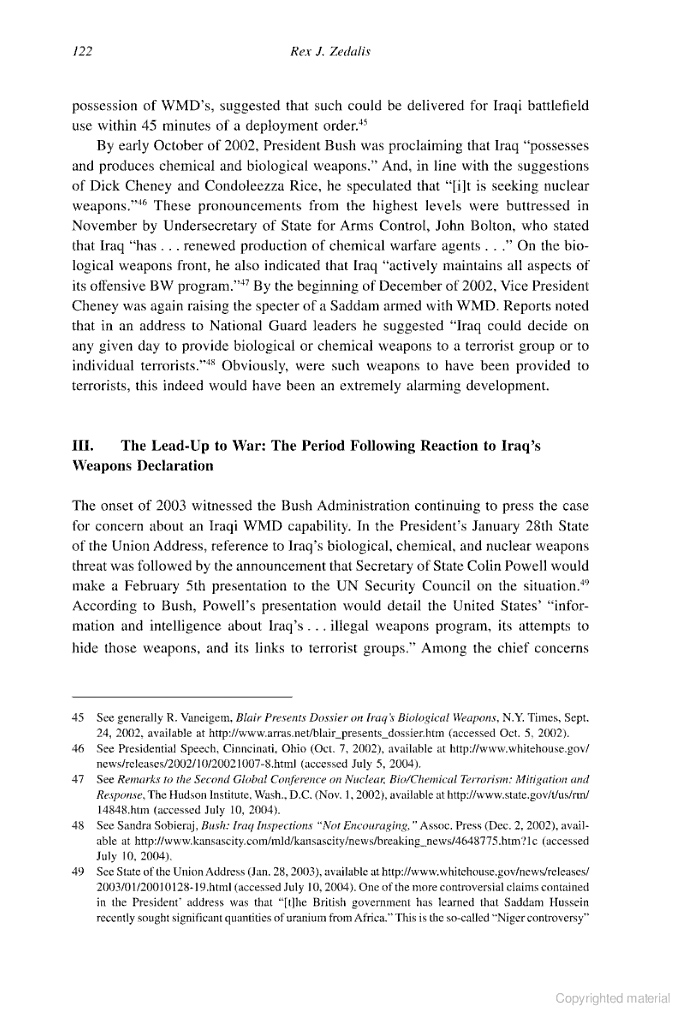
One of my old pieces that collaged New York Times articles and the writings of Situationist Raoul Vaneigem has found its way into a journal called International Peacekeeping. The authors cite the article, authored by one “R. Vaneigem,” as describing “the views of Prime Minister Tony Blair’s government on Iraqi possession of WMD’s.”

I can’t say that I’m proud of misleading a group of well-intentioned scholars about details of this most recent Iraq war, but then again, they should have read the article and noted its context on arras.net. They didn’t, in fact, quote from the text, and so Vaneigem’s impact on future historians’ views of the war will be quite minimal.

You can see the citation in footnote 45 (on the second page).

View pages on Google Books.

Or you could look at my screencaps. Click to enlarge:


I was throwing a party in my very unstable house in Philadelphia and wanted to strongly recommend, in fact command, my guests not to flush anything down the second-floor toilet that might clog it. So I created a simple “Uncle George Says…” poster in Photoshop that stated just that, but had so much fun doing it that I had to create more and hang them around the house.

In hindsight, the writing’s not all that good, but I think the concept of crafting an extended, largely paratactic George Carlin rant about things plummeting into the void, and that veers off into the political and surreal, is still interesting.

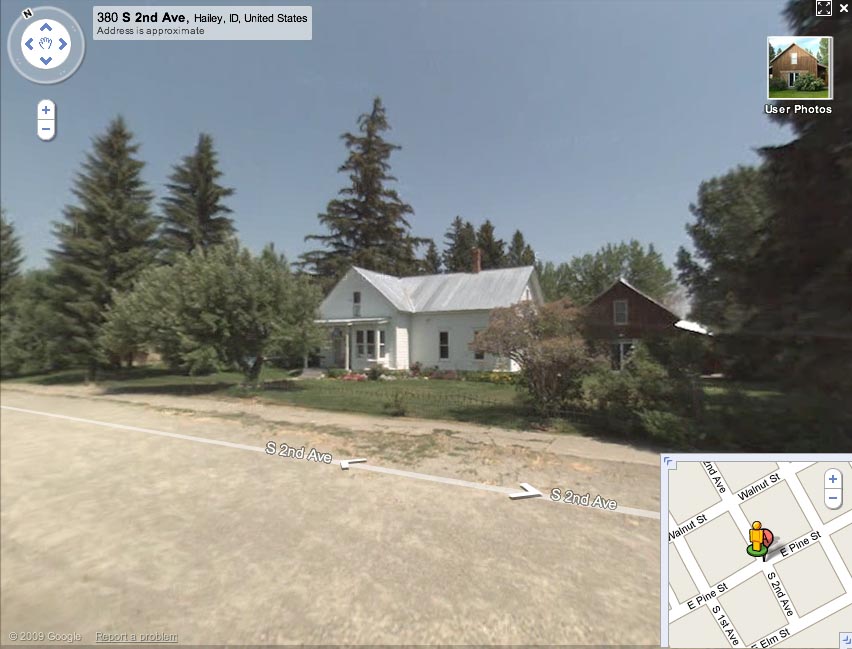
The kind of weird shit you can do with Google maps, visit the birthplaces of famous poets:

http://maps.google.com/maps?client=safari&rls=en-us&q=Second%20Ave.%20and%20Pine%20St.%20in%20Hailey%20Idaho&oe=UTF-8&um=1&ie=UTF-8&hl=en&sa=N&tab=vl

Now, I don’t exactly know what you’ll get by clicking the above link. Will you get street view automatically? Can’t say. But if you’re not quite sure what to look for, here’s a photograph I took while visiting Ezra Pound’s childhood home in Hailey, Idaho, early this morning at about 3. That’s me in the yellow jumpsuit.

Coming soon: photographs of William Carlos Williams’ house in Rutherford, New Jersey, which I have actually visited — as a patient!

« Previous PageNext Page »