So say we all…

http://segueseries.blogspot.com/

SEGUE READING SERIES
@ BOWERY POETRY CLUB

Saturdays: 4:00 p.m. – 6:00 p.m. 308 BOWERY, just north of Houston $6 admission goes to support the readers

FEBRUARY 28

JOHN GIORNO and BRIAN KIM STEFANS

John Giorno is the author of many books of poetry, which have been translated into several languages. Subduing Demons in America: The Selected Poems of John Giorno, 1962-2008, a career-spanning survey of his work, will be published by Counterpoint/Soft Skull in 2008.

Brian Kim Stefans’ most recent books are What is Said to the Poet Concerning Flowers (Factory School, 2006), Kluge: A Mediation, and other works (Roof, 2007) and Before Starting Over: Selected Writings and Interviews (Salt, 2006). He just moved to Los Angeles to take a position as professor of English and Digital Humanities at UCLA.

It’s like a little poem, really:

There are skills on display here that I can’t begin to comprehend.

Please join us at 21 Grand on Sunday, February 15 at 6:30pm as The New Reading Series welcomes…

Laura Elrick and Brian Kim Stefans
21 Grand
415 25th St (@ Broadway)

$3, BYOB

LAURA ELRICK lives and works in Brooklyn, NY. Her books of poetry include sKincerity (Krupskaya 2003) and Fantasies in Permeable Structures (Factory School 2005); some audio pieces and an interview can be heard on the Ceptuetics radio show here: http://ceptuetics.blogspot.com/2008/04/anne-tardos-laura-elrick.html. She has been a contributing editor to Future Poem Books and is currently on the organizing committee for the Advancing Feminist Poetics and Activism conference to be held in New York next Fall. On Feb 15, Laura will be performing her video/poem Stalk, which includes documentation of a recent spatial-poetic intervention into several prominent Manhattan commercial districts.

BRIAN KIM STEFANS’ recent books include Kluge (Roof Books, 2007), What is Said to the Poet Concerning Flowers (Factory School, 2006) and Before Starting Over: Selected Essays and Interviews (Salt Publishing, 2006). Recent digital projects include the interactive Kluge (http://www.arras.net/kluge/) and a series of digital projections called “Scriptor” that are intended for gallery and environmental settings, one of which appeared in the shown “Contranym” in New York City’s ABC Gallery in September, 2008. He is presently Assistant Professor of English and Digital Humanities at UCLA and lives in Los Angeles half a block away from Scarlett Johansson (‘s face on a billboard).

newyipes.blogspot.com

I’ll be reading at this event… hope to catch up with a lot of you in San Francisco!

The reading is on Sunday, Dec 28th at the Forum at Yerba Buena Center for the Arts on 701 Mission Street between 3rd and 4th Streets. The event starts at 7:00 and will go until 10:00.

SPDposter.jpeg

More from the paper files… this is the hand-out I created for a talk at UCLA last February. I’d like to develop these ideas into a fuller paper that creates a basic, very basic, set of critical principles by which to discuss the widely divergent forms of digital literature out there.

The pieces I discussed were Talan Memmott’s Self Portrait(s) [as Other(s)], Christian Bök’s Eunoia, Stuart Moulthrop’s Pax: An Instrument, and Judd Morrissey’s The Jew’s Daughter. Eunoia was included primarily because it was highly informed by information aesthetics without having any of the classic features that one associates with print works that play on tropes from electronic literature (the novels of Mark Danielewski, for example).

I created a blog for the talk which elaborates on many of these principles in more detail, though none of the literary analysis is up there. (There is a much weaker, earlier form of this talk available online in audio form, but I won’t point you there as I don’t quite endorse it — it was just a bare sketch of the later talk, which itself did not have all of its terms settled. But in case you’ve heard it already, here’s me telling you that I’m not entirely behind it.)

The “Holy Grails” that start off the talk are really my thinking through, and simplifying, the vast array of tropes that I see appear in various works of criticism about electronic writing. If there is a “telos” in the development of electronic writing — these are often alluded to in the criticism — it seems to be toward a few horizons, usually using as a departure point some notion of the “author” and the “page” (or book). The third “grail” is a more recent addition, due to the greater visibility of video games as possible forms of art (see my previous post).

My notion of “crisis” comes out of Frank Kermode’s The Sense of an Ending: Studies in the Theory of Fiction, so to this degree I was observing these works as “fiction.” Basically, Kermode reads narrative fiction, particularly novels, as setting up moments of anticipated “apocalypse,” which it can either satisfy or betray during the course of the narrative. It is during these crises that one can situate oneself on the narrative timeline, knowing where one is in relation to the “arc” of the story. (I am oversimplifying, of course.)

Since, indeed, most of the works I discuss are not narratives in a conventional sense — and do not have the sort of teleological drive that narrative fictions have — these crises must be replaced by something else. I took a few shots at what these could be, though I’m quite sure these seven categories are not the right ones (a few are, a few not). I was being a bit superstitious with my numbers here — 3, 7, then 1 — and might have fudged in trying to get everything all Pythagorean.

I introduced a new genre of writing for object-based environments, the “Surrealist Fortune Cookie.” It’s briefer than a “lexia,” something that could be reshuffled and reconfigured endlessly without losing its charge. I quoted a few lines from John Ashbery’s 37 Haiku as examples. My contention was that databased bits of text that are to be reconfigured algorithmically are most successful when they have elements of the surrealist haiku (or fortune cookie) as they are fragmentary (but can stand alone), enigmatic (more question than statement), and narrative (but without a closure).

After introducing these basic concepts, I then went through the four works (actually, only two works, as I ran out of time) and tried to evaluate how they operated in terms of the grails, the crises, and finally, in terms of the “surrealist fortune cookie.” Of course, the relationship of each of these works to the concepts varied greatly.

Language as Gameplay: From ‘The Oulipo to the Jew’s Daughter

Brian Kim Stefans, 2/12/08

The Holy Grails of Electronic Literature

Writing Without the “Author”: To write a piece that can be read several different ways – none predetermined by the “author” – which will provide distinctive, compelling reading experiences each time – that is, displacement of the “author” onto the algorithm.

Reading Beyond the “Page”: To write text for an environment that serves a textual function at nearly all times while maintaining the illusion of a dynamic, three-dimensional, processed space that is moving as far away from the “page” as possible.

Writing/Reading as Gameplay: To create a programmed object that serves equally as a piece of literature and which also serves as a “game” with all the “fun” implied in such a title — that is, to in­corporate the user completely into the world of algorithm and the world of the screenspace.

Seven Varieties of Crisis

1. Crisis of ESCHATOLOGY — we are not sure where, in the standard narrative paradigm, poetic paradigm, or essayistic (syllogistic) paradigm, we are located nor can we, for the mo­ment, imagine the end.

2. Crisis of SIGNIFICATION — something has occurred in our understanding of conventional relationships between word and thing, or even letter and word; language seems to be becom­ing pure inscription and “non-referential.”

3. Crisis of SYMBOLISM — something seen to have a merely contingent value is seen to have a role in a symbolic universe.

4. Crisis of SUBJECTIVITY – the narratological “I,” whether of third or first person, has shifted.

5. Crisis of GENRE – we have slipped from a narrative event to a poetic one, or more criti­cally, from a non-fictional, documentary mode to one that seems colored by the imagination of an “author.”

6. Crisis of MORALITY – something in the flow of words has forced us to question our own place in the social network due to the “danger” of assimilating these words into our experi­ence – i.e., will I choose to “own” this reading experience or not?

7. Crisis of AUTHORSHIP – something in our reading has suggested a shift from a largely au­thored universe – hence a conversation with another responsible individual – to a largely al­gorithmic one — a conversation with a (“schizophrenic”) robot.

What is a Surrealist Fortune Cookie?

A “Surrealist fortune cookie” is a single sentence that would touch off same element of the various “crises” noted above — a non-trivial reading experience that is brief, open-ended, and yet acquires the enigmatic (permanently “revolutionary”) quality of a Surrealist object – straight out of the world of the Comte de Lautreamont, who wrote of the beauty of “the chance meeting on a dissecting-table of a sewing-machine and an umbrella.”

Ok, well that’s a pretty heady title. I wrote this short document up about a year ago in preparation for my “Video Game Narrative Studies” class in Richard Stockton College. It was an odd and very experimental class, but I think I came up with some interesting ideas on how to teach such a thing.

Anyway, unrevised, here is the “manifesto,” which — frankly — I completely forgot about after I wrote it (it was never given to the class, I believe). I simply rediscovered it in my papers (luckily, I had printed it out, as my computer was stolen in late July and I didn’t have a back-up of this file).

Here’s the website for the class, Video Game Narrative Studies. I asked one of my students to contribute his paper — discussing architectural conceits in Oblivion and Second Life via Barthes’ Empire of Signs — to the arts website I created at Stockton, Richard Stockton Overdrive, which you can read here.

I realize writers like McKenzie Wark and Ian Bogast have answered, or at least discussed, many of the following questions and issues in great detail, and with more nuance than I could ever muster, but I think there are a few interesting, original nuggets in the following.

A Manifesto For Video Game Developers

Much has been made about the possibilities of video games to “tell stories” with the same impact of films and novels. Though much game development has been moving in this direction, the directions game designers have taken have gener­ally been two-fold: pushing for greater detail in the simulated gameworld (rang­ing from light effects to facial expressions), and greater complexity to the back story of the game (much of which is mistaken for the actual “embedded” content of the narrative).

There are several approaches that game developers can take to enrich their narra­tives without sacrificing gameplay. The present offering, by a person who has never designed a video game*, is intended to encourage game developers — many of whom are independents with resources on a par with the industry — to take the risks that dramatists, novelists, filmmakers and, yes, poets have taken with their arts for centuries.

*Not entirely true — I designed tons for the Vic-20 back in the day.

1. Story

The novel and the feature film have less to do with each other than one might initially think. Feature films, in fact, might bear a stronger relationship to the lyric poem than the novel, given the rigidity of a movie’s 3-act narrative structure and the awareness that the reader of the poem has of the poem’s duration.

Complicating components include the variable time factor between narrative “events,” the structure of databased information versus the linearity of sequen­tial events deemed necessary for a “story,” and the perspective of the “player” as character within game worlds.

Two issues that will be discussed will be that of the variably placed “plot point” that suggests the narrative structure to the viewer, and the issue of “telos” in a game world predicated on the reproducibility of effect, looped narrative struc­tures, as well as mods by which the user extends the game world.

Tying “story” to “character” will be a consideration of the monomyth, including questions of reversals of characters, the shape of the narrative as visible to the “first person” player, and the descent into hell.

2. Character

Characters who, like Peter Lorre in M, start as highly unsympathetic but who turn out to have human dimensions that make us question our entire moral universe. The Golem — and his enslavement and hence humanization by the Hobbits — is another example.

Can the user be forced to occupy this morally ambiguous space of a character without, on the one hand, putting an estranging irony between oneself and one’s avatar so much that the connection lacks urgency, and on the other identifying so strongly with the moral ambiguity — and growing so uncomfortable with it — that the game ceases to be “fun”?

The “otherness” of NPC characters is not often appreciated. Characters are either human puppets (on either end of the good/bad binary) or are monsters which might have a greater chance at occupying this morally ambiguous space, but who are nonetheless “monsters” and hence overtly “other.”

Also to be considered will be the issue of a “fluid” consciousness — an experienc­ing consciousness not bound by time constraints, or if by time constraints, ones that are as variable as “frames per second.” How is a player to understand and read the important “plot points” without the obviousness of a cut-scene? Can a player be expected to engage in an interior monologue of some emotional com­plexity while also engaged in play?

3. Art

Games are a form of “task-based” interactive art. The distance between interac­tive paintings such as those by Camille Utterbeck and the Austrian artist tu­rux.org and the “synaesthetic” games such as Rez and Everday Shooter has shrunk, such that one must look video game visuals as more than dressing up the play of other­wise anonymous algorithms.

Prior discussions of the visual aspect of games have concerned itself with model­ing and mise-en-scene i.e. those aspects of video games that most resemble movies. However, at any given moment on a screen, the trajectory of objects, the abstract clouds of detritus and fire that characterizes an explosion, or the swoop­ing in an out of the camera, gives us a for more abstract “beauty” to deal with, akin to the fetishization of speed and. motion that the Futurists and Constructiv­ists (informed by the writing of philosopher Henri Bergson) exploited.

The success of games like Geometry Wars — a fairly unadventurous shooter in terms of gameplay — demonstrates the gamer’s interest in becoming part of a world that, for all of its obvious sensual offerings, is primarily abstract. The coll­pasing of the grid into the trail of the player’s spaceship is suggestive of some sort of expansion of the subjective experience of play into the underlying grid-work of the algoriths — or is it?

Is there a philosophical perspective being articulated here? Is this a questioning of the stranglehold of societally sanctioned “time” and “space” on an individual? Is there an economics of waste being explored here?

5. Spaces

Henry Jenkins writes of “embedded narrative” and various sub-genres affiliated with it, claiming that video games tell a large part of their stories in the very spaces that are to be explored. However, most of the narrative that is revealed via these processes can still be folded under the concept of “backstory” ele­ments of narrative that pre-date the parts that compose a “strong” narrative that could provide for such elements as catharsis and character reversals. What Jen­kins doesn’t consider, however, is the sense of the gameworld being “othered.”

Consequently, how does the Situationist concept of the “derive” play out in video games? Is the exploration of a game space truly akin to the Surrealist-inspired interactions with “chance” that they are often valorized as? How does the revival of interest in psychogeography – in a user friendly kind that relies on absent narrators communicating through cellphones – relate to the open-ended structures of the Situationists? Is there really possibility for the “chance encoun­ter” or “chance juxtaposition” in a video game?

Games that we can consider range from the compacted image of New York pre­sented in The Godfather to the very realistic architecture of JFK Reloaded. Archi­tecture might, in fact, be our closes approximation to “reality,” and hence the presence of the auteur — that one who is enslaved by corporate structures and ideology but who must nonetheless find expression between the cracks (or edits) — might best be found here.

Are video game spaces — the empty parts — the primary architecture of video games, and what we actually see the “empty” parts?

5. Architecture

The “beautiful ruin” has been a staple of several architects of the last century, primarily by Louis Kahn, but also the Nazi Albert Speer. Not surprisingly, many video games seem to valorize these same principles, opting for the evocative post-apocalyptic tenor over the clean-structured, fully operational modern, pro­fessional note.

We also understand the unfolding of representational elements in video games, either through cut scenes or otherwise, as reliant on the sorts of strategies com­mon to comics, not to mention the gestalt-switch conundrums of an artist like M.C. Escher. The key issue is to determine how images unfold through time, how it is that we perceive these images, many of which will be unique but then again pre­determined by algorithm, and thus our appreciation as well of “chance” in a con­trolled environment.

Lastly, we will explore the relationship of video game architecture to the “American vernacular” as explored in Venturi’s Learning from Las Vegas. Is it pos­sible that architects have something to learn with the way game worlds are de­signed — in terms of the perspectives they offer, for example, on ruined portions of their creations. How is power conveyed through perspective?


…in San Francisco at the end of December. Let me know if you’ll be around (looking for a couch to crash on, actually). Be reading at the big poetry shebang on the 28th and a discussant on a panel concerning experimental literature in Asia. Details below…

***

Sunday, December 28th

Small Press Distribution is hosting this year’s MLA off-site reading for visiting poets on Sunday, December 28th from 7-10. With the generous sponsorship of the Poetry Foundation, we have secured the Forum in Yerba Buena Center on Mission Street between 3rd and 4th Streets in San Francisco. It will be a nice space to read in and is located within a few blocks of all of the MLA hotels. We expect to include 60 or so readers from out of town, along with a few local poets, in the event. There will be many great readers, books galore and much else to please and surprise you. Brent Cunningham and I will be your emcees.

***

Monday, December 29th

695. Literary Experimentalism in East Asia

7:15–8:30 p.m., Nob Hill D, Marriott

Program arranged by the Division on East Asian Languages and Literatures after 1900

Presiding: Walter K. Lew, Univ. of Miami

1. “Digital Complex: Redefinition of Literary Sensibility in Japan,” Koichi Haga, Josai International Univ.

2. “Writing Machine Collectives: Digital Poetry in Hong Kong and Taiwan,” Karen An-hwei Lee, Santa Ana, CA

3. “Negotiating between Languages: The Poet Kim Su-yông’s Resistance to Monolingualism in Postcolonial South Korea,” Serk Bae Suh, Univ. of California, Irvine

This blog post title is taken from one of the links below, a new slew of minor hits, this time using the single word “Toadex” in Google.

Nothing incredibly revealing here except that there is a “Toadex” appearing on a few forum pages (Newgrounds, for example), and there seems to be more evidence of actual correspondence between Mr. Toadex and a few blog authors.

These links are a mess; some are already from my previous post but I don’t feel like weeding out the doubles.

Geegaw
Some literary analysis of a recent Dagmar Chili post:
http://www.geegaw.com/archives/0111.shtml
Correspondence with Toadex?
http://www.geegaw.com/archives/0302.shtml

Apathy
I think these are in the previous post:
http://apathy.pitas.com/06_18_2000.html
http://apathy.pitas.com/04_09_2000.html

Newgrounds
Someone named Toadex contributed to these forums (probably more if I really searched):
http://www.newgrounds.com/bbs/topic/128663/14
http://www.newgrounds.com/bbs/topic/310812

Sylloge
More correspondence:
http://www.sylloge.com/the_past/2001_03_01_not_recent.html

Amiright
Nothing to do with our author, I think, but the cane toad chemical called Toadex:
http://www.amiright.com/parody/70s/johndenver44.shtml

Synthetic Zero
Another Toadex watcher from back in the day:
http://69.93.195.170/may2001a.html
And folllowing, some correspondence:
http://www.syntheticzero.com/jan2002.php
http://www.syntheticzero.com/dec2001.php

Webwasp
Someone named Toadex contributes to this as well:
http://www.webwasp.co.uk/forum/index.php

Metafilter
This has nothing to do with our author, but the great line that forms this post title is from here. Bonney’s translations of Baudelaire are interesting.
http://www.metafilter.com/63023/Sean-Bonneys-Translations-of-Baudelaire

Green in Australia
Information on “Toadex,” a spray for killing cane toads:

Control of cane toads is extremely difficult. Reproductive potential is high. Traditional techniques of dispatch are painful for the animal. Toadex is a new commercial spray product specifically for cane toads. However freezing is the most humane way to kill them. A CSIRO research program to investigate possible biological control options is in progress.

Evon Evonchoo
The Google search for Toadex led me to this blog which also engages in some strange language play, for example:

toadex went sch , supposed tuu miit ddear e lorhx , bud she cant make iit , den neber go , ad fiirst iintend tuu skiip sch and go shopshop wiiv her !!! L0ls ..
had sum funn iin e recess , chungg told miie tat e church hab dunnoe wad iindustriiex programme , den she saex iie can joiin e fashiion iindustriiex , bud e fuckiin edna saex tiis : afta e LV iinciicdent , can she stiilll make iit ? iie wanna roar !! iie hab alreadiiex regreated wore lyetat and euur hab been laughiin ferr almost 1weeks le lehx !!! L0ls .. home-ed and catch sum tv and chated on phone wiiv edna jux nao ..

Athica
Dagmar Chili included in an online web gallery — without permission, of course — created by a group in Athens, Georgia.
http://www.athica.org/virtualart.php

Some time ago, when I posted a .pdf version of “Name: A Novel” on /ubu editions, I noted that there were exactly 4 Google hits for the author of the book, Toadex Hobogrammathon. Memory being what it is, I can’t remember what those links were, but I gave it another shot recently to see if I could dig up something about this mysterious personage. To date, I know of only the following which can be directly attributed to him/her, or at least to this pseudonym — there might be others out there. Two are weird blogs, one is the novel.

The primo blog to read by Toadex H. is Dagmar Chili Pitas. I’ve already linked to this blog from FSC, but haven’t as yet done any serious writing about it. The real title might just be “Dagmar Chili,” “Pitas” being simply the name of the service provider. But like Kleenex and Xerox, the name seems to have stuck.
http://dagmar_chili.pitas.com/

What appears to be a test run up to Dagmar Chili Pitas is Doxo Wox. I found out about it on a blog that seemed to be following Toadex H. back in the day. I haven’t seen proof, other than a similarity of style, that this is by Toadex H., but the similarities are strong (or more particularly, with the early part of Name, the next link).
http://doxowox.org/

And then there is Name: A Novel, which I describe in some detail on the following page.
http://ubu.com/ubu/toadex_name.html

I can’t find the original page on which “Name” first appeared. I don’t remember who among us (mostly like one of the ubuweb folks) discovered it. But I do remember exchanging an email or two with Toadex about putting it up, all lost in one of several crashed or stolen hard drives.

In any case, I’m trying to, uh, research Toadex Hobogrammathon for some writing I hope to do on digital poetry and the whatnot. Below are the only links (not including links to the ubu page, of which there are several) that come up with “Toadex Hobogrammathon.” Appears that, at some time, he/she occasionally dropped a note on some blogs regarding some issue (Zukofsky one time) that needed addressing, though in typically off-beat fashion.

One poster writes that “Mr. Toadex is a friend” of his/hers, that person being listed only as “a” (with no email address). So I’m hardly hot on the trail. But if any of you out there (does anyone read this blog anymore? If not, I understand, it’s sucked for so long) know anything about Toadex, drop me a line.

Erswhile.net
http://erstwhile.net/?t_z=1091343600&t_s=2678400

Apathay
(Hmmm… didn’t realize that apathy was housed at pitas.com, maybe this is the break I needed.)
http://apathy.pitas.com/compconc.html
http://apathy.pitas.com/04_09_2000.html

Bellona Times
http://www.pseudopodium.org/ht-20011014.html

It’s at this website that Toadex asks about Zukfosky:

thro yr Ardent urgency, have I can come to Z;
accidental Ctrl-b, close window, I wrote a something to Ray, … ;;;; What may I be writing an Rutgersial anthological comment on Zukofsky, do yo have any bookings to recomment,?? Or articles?? Are you attributed to him?
I mean, I’m drafted by class, to write by an anthology of Rutgers, what Z did and said, and so forth. I got a goddamn refridgerator the last guy had to assault me with some whirr less than buzzing, when one dranks enough to listen.

And before a four days ago, I didnaot know tha te emoeuseic of A24 is H via C, so enough of tracking up and through the left,

good days to you and thakn yuo of all the

Gewgaw
http://www.geegaw.com/archives/0111.shtml

Miette’s Bedtime Story Podcast
(It’s in this one that one of the commentors mentions that Mr. Toadex is a friend, in the same sentence as recommending Kenneth Goldsmith’s Fidget for a conceptual audio project.)
http://www.miettecast.com/2006/09/30/the-scarlet-ibis/

[Postscript: the word “Toadex” brings up several more hits that are relevant, but I don’t have the time right now to post them. Will soon.]

I can’t believe the absurdity of the Best American Poetry series’ “Write and Inaugural Ode” contest. Could there be any “integrity” in a project (see list of magnilquent abstractions that they require be used in the poem) that requires that a line from the poem be taken from a poem in this year’s edition (or from the foreword or introduction). This, I am guessing, is to prove that you indeed have a copy of this year’s edition — a marketing ploy!

I suppose poets aren’t to be trusted to write inaugural odes on their own, uncoached by the aesthetics of Hallmark or the 30-second campaign ads available on YouTube. So much for going in “fear of abstractions” (as Pound suggested) — the Best American Poetry asks you to bathe in them. And why don’t they just ask you to write a poem about Barack Obama — must we be so sly? The election’s over!

This really did depress me, coming from such a visible and often provocative publication series. This is just asking poets to be dumb.

THE CHALLENGE: Write an Inaugural Ode

http://thebestamericanpoetry.typepad.com/

Write an inaugural ode, suitable for reading aloud on January 20, 2009. It must consist of sixteen lines broken into four quatrains, rhyme scheme optional. The ode must include one line lifted from a poem in The Best American Poetry 2008 or from the book’s foreword or introduction, and it must also include at least three of the following words: honor, integrity, faith, hope, change, power.

&tc. &tc.

According to my air conditioner repairman here in Los Angeles, this guy used to live in my apartment with his mother (who died last year at the age of 91 or so). Maybe not as exciting as living in the house that Syd Barrett lived in, but it’s nice to know the history.

EduardGufeld.jpg

Eduard Y. Gufeld, a chess grandmaster and prolific chess writer who coached many Russian players, including the former women’s world champion Maya Chiburdanidze, died on Monday in Los Angeles. He was 66 and had lived in Los Angeles since 1995.

Mr. Gufeld’s death, at Cedars-Sinai Medical Center, occurred two weeks after a stroke, said Dr. Anthony Saidy, an international master and a friend.

By the standards of the Soviet Union, Mr. Gufeld was only a moderately successful chess player. His best finish in the Soviet Championship was a tie for seventh place in 1963.

Still, Mr. Gufeld was among the few Soviet grandmasters allowed to travel freely outside the Soviet Union in the 1970’s and 1980’s, a privilege usually reserved for the best players.

There were rumors that Mr. Gufeld was permitted such freedom because he was working with or for the Soviet secret police, but friends and people who met him on his travels discounted that.

”He was the good-will ambassador for Russian chess,” Dr. Saidy said.

A large man with an engaging personality, Mr. Gufeld had a childlike obsession with chess, friends said. When he lost, he often threw tantrums and even cried.

He wrote more than 80 books, including an autobiography, ”My Life in Chess” (Inside Chess Enterprises, 1994).

Some reviewers said he sacrificed quality for quantity, reusing material from book to book.

Eduard Yefimovich Gufeld was born on March 19, 1936, in Kiev, Ukraine. He became a grandmaster in 1967. In the 70’s and 80’s, he trained the Soviet teams that dominated the Chess Olympiads.

He is survived by his mother, Eva Yulievna Novak, and his sister, Lydia Valdman, who moved to Los Angeles with him.

He was married to a Georgian woman and had a stepson. Dr. Saidy said that Mr. Gufeld had had no contact with his wife and stepson for many years and that he did not know whether Mr. Gufeld was still married.

Mr. Gufeld summed up his feelings about chess by saying: ”For me, chess is life, and every game is like a new life. Every chess player gets to live many lives in one lifetime.”

Here are some recent, and not so recent, things written about my books and chapbooks over the past years.

I try to keep track of this stuff once in a while, since these books and things often seem to disappear into oblivion, and I like to think my poems and things are meaningful to someone… sigh. I’ve also moved four times in four years, now, and feel pretty out of touch with readers and writers, though finally settling in LA and meeting the poetry folks here and in San Francisco has been pleasurable (and a relief). “Stabilizing” might be more therapy-session way of putting it.

There are two interesting shout-outs tacked on at the end. First, is a poem by Rachel Blau DuPlessis, in which my Flash animation “The Dreamlife of Letters,” which borrowed liberally from a text of hers, is discussed at length in the footnote and poem itself. (She didn’t like the project at all, from what I understand, when she first heard about it and saw the poem, but I think she’s ok with it now. Maybe.)

The second is from the intro to the Cambridge Companion to British Romantic Poetry, in which my playful co-option (or “liberal borrowing”) of Blake’s “Proverbs of Hell” (along with other works by other poets like Ashbery, Muldoon and Lisa Robertson) is given as proof that British Romantic poetry is still very much alive and useful to poets of today (or something like that). Anyway, I thought it was funny.

Noah Eli Gordon
Boston Review
microreview of Kluge: A Meditation, and other works

Clive Thompson
Collision Detection (blog)
“Why Interactive Poetry Beats Interactive Fiction”

C St Perez
Tarpaulin Sky
review of What is Said to the Poets Concerning Flowers

Jason Morris
Jacket Magazine
“The Time Between Time: Messianism & the Promise of a ‘New Sincerity'” (general aesthetics essay discussing a number of poets)

Michael McDonough
Electronic Book Review
review of Before Starting Over: Selected Essays and Interviews

Michael McDonough
Econoculture
review of Fashionable Noise: On Digital Poetics

Stan Mir
Fascicle
“Matter Ordered to be Made” (review of several chapbooks)

Ben Basan
Luminations (blog)
notes on Fashionable Noise and some digital work

Mark Mendoza
Verse Magazine
review of “The Window Ordered to be Made”

Ron Silliman
Silliman’s Blog
review of “Jai-alai for Autocrats”

Jack Kimball
Talisman (print edition)
“Review of Carter Ratcliffe’s Arrivederci Modernismo, Laynie Browne’s Daily Sonnets, Brian Kim Stefans’s Kluge: A Meditation and Other Works

Mark Wallace
Verse (print edition)
review of Fashionable Noise: On Digital Poetics

K. Silem Mohammed
The Consequence Of Innovation: 21st Century Poetics (ed. Craig Dworkin, print)
“Creeping It Real” (this might be on his blog, Lime Tree, somewhere)

Rachel Blau Du Plessis
P.F.S. Post (blog)
Draft 59: Flash Back

James Chandler and Maureen N. McLane
“Introduction: The Companionable Forms of Romantic Poetry”

The irony of Silliman’s post about wanting to sue the creators of Issue 1 is that he posted the entire list of “contributors” to the volume on his blog. Of course, he merely cut-and-pasted it, but he doesn’t say that, and the implication is that he typed the list himself.

http://ronsilliman.blogspot.com/2008/10/one-advantage-of-e-books-is-that-you.html

The most “creative” aspect of Issue 1 was the collection of author’s names. One of Silliman’s favorite critical tactics (see the introduction to the In The American Tree and Art of Practice) is the list of excluded poets. By cutting-and-pasting this list on your blog without clear attribution, within the context of understanding that the mere list of poet names is a form of criticism, you are committing a sort of plagiarism not unlike the — whatever it is that Silliman is accusing the creators of Issue 1 of havng done.

He should redo the post and type the names in from scratch (the difference in typeface is the dead giveaway that it was pasted in). Or at least include the list author’s names (which, I suppose, he really can’t).

Or something like that — I’m really just pointing out an irony. Don’t ask me why I’ve decided to comment on this now, but Kenny Goldsmith gave a very interesting presentation at Untitled: Speculation of the Expanded Field of Writing conference here in Los Angeles that ended with a great discussion of the project — though, strangely, Kenny neglected to include the list in his excerpt from the blog post.

Friday October 24th to Saturday October 25th
At REDCAT, The Roy and Edna Disney/CalArts Theater
631 West 2nd Street, Los Angeles CA 90012

http://redcat.org/season/0809/cnv/untitled.php

FRIDAY October 24th

12.30: Opening Addresses

1.00-3.00: Litterality 1.
Writing is not speech, it is letters on a page. What do we make of the inclusion in writing of non-alphabetic signs, symbols, diagrams; writing as map or score; invented writing notations; or the book as object?
Johanna Drucker, Salvador Plascencia, Latasha Diggs, Shanxing Wang

3.30–5.00: The Meaninglessness or -fulness of Language.
As a vehicle, is language empty, saturated with meaning, both, or something else?
Jessica Smith, Bob Grenier, Christine Wertheim

5.00-6.00: Drinks at REDCAT with participants and audience

8.30-10.30: Evening Readings/Performances

SATURDAY October 25thMorning

10.30-12.00: Appropriation and Citation.
Whose work and what material gets appropriated, cited and resurrected? Who owns texts? Is there a difference between appropriation and citation?
Steve McCaffery, Doug Kearney, Kenneth Goldsmith

12.30–2.00: Litterality 2.
Writing is not speech, it is letters on a page. What do we make of the inclusion in writing of non-alphabetic signs, symbols, diagrams; writing as map or score; invented writing
notations; or the book as object?
Brian Kim Stefans, Julie Patton, Vincent Dachy

3.30–5.00: The Concept of Conceptual Writing.
What is the relation between conceptual writing and the trajectory of conceptual art?
Stephanie Taylor, Heriberto Yepez, Young-Hae Chang+ Marc Voge

5.00-6.00: Summary Discussion with all panelists

8.30-10.30: Evening Readings/Performances

September 4 – 28, 2008

Opening: Thursday, September 4, 6 – 8pm

chashama ABC Gallery
169 Avenue C at 10th Street
Train: F to 2nd Ave, L to 1st Ave

Gallery Hours: Wednesday to Sunday, 11a – 7p

contranym.jpg

New York, NY – The curatorial team of Kelly Kivland, Alisoun Meehan, and Christopher Stackhouse are pleased to present the exhibition, CONTRANYM, in conjunction with the New Voices, New York series at chashama ABC Gallery. Exploring the complexities and dubious nature of visual expression and vocal utterance, CONTRANYM will present how language is dependent on the dualities of silence and absence, presence and matter. The exhibition will include the following works by Robert Delford Brown (performance), John Cage (painting), Victoria Fu (video), Stephanie Loveless (sound/performance), and Brian Kim Stefans (digital poetics):

Robert Delford Brown, Explosion of a Tile Factory
John Cage, 10 Stones
Victoria Fu, The Lake House
Stephanie Loveless, (nothing of nothing)
Brian Kim Stefans, Scriptor

During the opening reception, visitors will be part of an original Robert Delford Brown interaction. A Fluxus artist who began his artistic life in 1950s NYC, Brown will transform the gallery front into a vibrant explosion of recycled materials, as part of a collaborative installation that is testament to joint, spontaneous action. Armed with the duct tape, string, scissors, spray paint, and newspaper, Brown and visitors will collectively create a temporary sculpture splayed out from floor to ceiling.

“The ecstatic power that has marked Brown’s art since the 1960s threw a monkey wrench into the avant garde in those days. He touches a nerve at the core of the social codes that organize not only our behavior but also the limits of our art…Robert Delford Brown’s transcendent vision takes on a great significance.” – Allan Kaprow

In John Cage’s “10 Stones,” painting functions as spiritual notation creating a lexicon beyond letters. The chance stone tracing is based on Cage’s ‘Where R = Ryoanji’ drawings inspired by the Ryoanji rock garden in Kyoto, Japan – a seminal meditative work on material and transformation.

Victoria Fu’s short video, “The Lake House,” is a palindromic riddle illustrating the convergence of affection and opposition, intimacy and estrangement in human interaction.

Brian Kim Stefans, editor of the new media poetry website www.arras.net, will premiere the digital poetics work “Scriptor,” featuring dynamically generated, largely scriptural typeface that anthropomorphize words and text with Flash animation.

The premiere of Stephanie Loveless’ sound installation in continuum, “(nothing of nothing),” developed through live performance throughout the exhibition run, weaves and re-envisions the voices of iconic divas, splitting the ghostly from the presently living, the preternatural from the basic material.

***
chashama is a non-profit arts organization that provides opportunities for performing and visual artists. We support the development of art by awarding grants, producing shows and providing subsidized studio, rehearsal and performance space. Since 1995, we have provided artists with a home and the support resources necessary to present and create art that engages the community of New York. For more information, please visit www.chashama.org

Here’s an interesting development in the world of Debord and plagiarism… I’ve just downloaded the beta version of the game. The story is from Rhizome — here’s the rest.

KS_screenshot_08Jan30efinal1.gif

“Ideas improve. The meaning of words participates in the improvement. Plagiarism is necessary. Progress implies it. It embraces an author’s phrase, makes use of his expressions, erases a false idea, and replaces it with the right idea.”

So wrote Guy Debord, prominent member of the Situationist International and major instigator of the infamous Paris uprisings of May ’68. In his most famous text The Society of the Spectacle, Debord articulates the belief that free trade of thoughts and ideas is not only acceptable, but necessary for the intellectual advancement of culture. He did not simply advocate plagiarism as a means of reference, but as an active way to critically engage and subvert dominant media images — what he and his fellow Situationists referred to as ‘détournement.’ Put simply, détournement is the appropriation of these prevailing images for meanings in opposition to their original intent — a strategy that has influenced generations of activists, academics, and artists. So when the estate of Guy Debord recently sent a ‘cease and desist’ letter to a group of American artists for copyright infringement, people familiar with Debord’s oeuvre were rightly shocked. Beyond the obvious irony of the situation, this particular case has raised questions about the complexities of copyright, monetary compensation and the historical legacy of our anti-establishment icons.

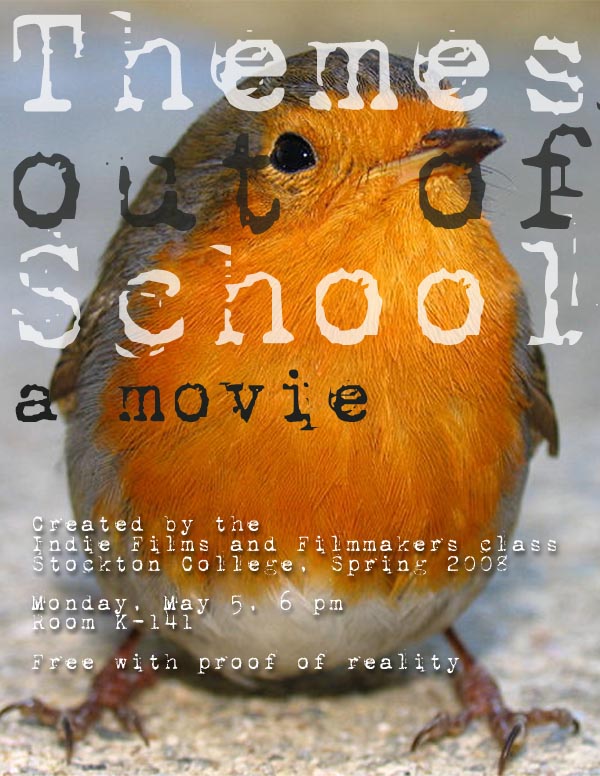
Here’s the little poster I designed for the premiere of Themes Out of School at Stockton College (see below for links to the online version). Click to enlarge.

themes_poster.jpg

I’m happy to announce that two Stockton efforts from the Spring 2008 semester are finally online. Check them out, and send to friends!

“Themes Out of School”


Themes Out of School (part 1 of 5) from Brian Stefans on Vimeo.

A 45-minute featurette made by the students of the Indie Films and Filmmakers class of Stockton College, Spring 2008.

Five short interlinked movies that follow the lives of students in the South Jersey area, ranging from “Clerks”-style slacker humor to deeper, quieter meditations on youth identity — and a lot of beyond and in-between!

Directors include Patrick Dawson, Kelly Cochran, Jakob Strunk, Sarah Hinkle and Brian Blazak. There is a cast of millions, notably Clarence Pugh, Maryellen Dierkes, Garrett Stites, Jackie Dunay, Meredith Malloy, Scott Staglias, Michael Clark, Brian Sullivan, Brittany Caserta, Brittany Tenpenny, Derek Forrest, Keri Tinagero, Anthony Mauriello, Pamela Staszczak, Geoff Kuinmir, Donald Blair and Sean Herman. Also starring Nathan Long as the Nutty Professor.

It’s on Youtube, but also on Vimeo, which has MUCH better video quality:

Youtube:
http://youtube.com/watch?v=Ep9yeu7kVrA

Vimeo:
http://www.vimeo.com/1055132

“The I-wing Nomad (A Musical)”

The I-wing Nomad is a collaborative musical that takes place in the G-wing cafeteria at Stockton College. It relates the story of Alex, a student who spent an entire semester living in the rafters of I-wing (based on a true story) and the dogged pursuit of two nosey Argo reporters to find out who he is (not based on a true story). A staged reading of the play occured May 2nd, 2008, in the G-wing cafeteria from 2 to 2:30 while it was still open.

The play is a sort of rondo, with four sets of actors playing four versions of the same characters, a form inspired by the plays of Maria Irene Fornes, Jeffrey Jones and David Ives. And there are songs — inspired by Willy Wonka, Lynyrd Skynyrd, Don Felder, and David Bowie!

Authors include Joshua Baechle, A J Colubiale, Cathleen Dower, Maureen Egan, William English, Rachael Finley, Kristy King, Christopher Kocher, Angela Kramer, Sarah Lyman, Timothy Merle, Molly Minehan, Marilyn Mitchell, Scott Oliver, Preston Porter, Jessica Schlueter, Zack Scott-Sedley, and Stephen Voloshin. Brian Kim Stefans and Rachael Finley did the final edits.

Any visual glitches are due to errors on the cheap video tape we used during filming.

Youtube:
http://youtube.com/watch?v=bFd7Z1SJm3g

You can read the play here:
http://overdrive.thefhiz.com/play.htm

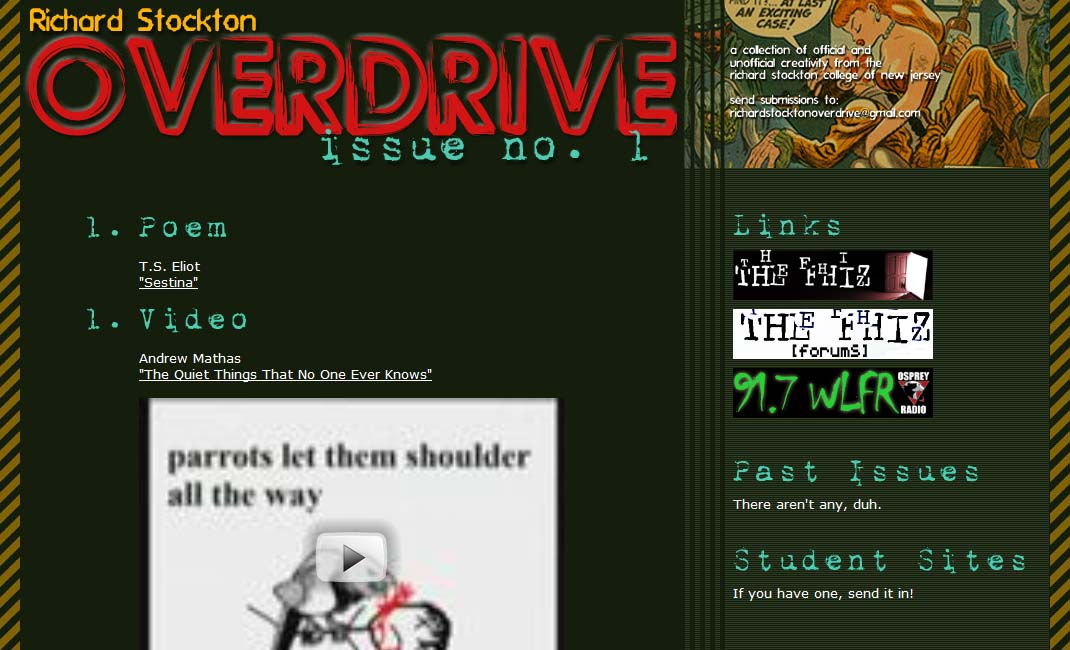
My latest little project has been creating an all around arts site for Richard Stockton College where I’m teaching. The site is called Richard Stockton Overdrive (a name inspired by Bachmann Turner Overdrive, of course). It’s for “official and unofficial” creativity, meaning that I want students to give me stuff from their classes but also their own private ventures, much of which seems much more interesting to me than class work.

It’s not “launched” yet — the content on the site is either bogus, stuff I ripped from the web, etc. I plugged it all in just for design’s sake. The image in the upper right will change with each issue — perhaps the entire color scheme will change — and the categories that I have are just the first group I could think of. They will also alternate depending on content.

But one rule will remain constant, which is that I just want one of each thing for each issue. This keeps the size down, so people know they can more or less get through an issue in less than an hour. Too many webzines overload their contents, and so what happens (in my mind) is that I peruse a few things and maybe bookmark it, but don’t visit it again until I get the announcement for the next issue.

There’s some trash aesthetic going on here — I wanted it to have some underground feel to it — but has some elegant touches, to make it professional-looking.

stockton_overdrive.jpg

Please join Les Figues Press and editors Christine Wertheim & Matias Viegener, to celebrate The noulipian Analects, an alphabetical survey of constrained writing by some of today’s most innovative writers.

90.jpg

Hosted by: Robert Fitterman

With readings by contributors: Christian Bök, Vanessa Place, Brian Kim Stefans, Rodrigo Toscano, Matias Viegener, and Christine Wertheim

Thursday, January 31, 2008
7:00 p.m.
The Mercantile Library Center for Fiction
17 East 47th Street
New York, NY 10017

For more info see:
http://www.lesfigues.com
http://www.mercantilelibrary.org/events/readings.php

About the book, in the words of Charles Bernstein
[The noulipian Analects is] An Alpha Bestiary of Exogenously Exotic Essays and Dazzlingly Delectable Design, Complexly Charismatic Constraints and Occasional Oulipian Outrages, Thoughtful Theoretical Threads and Ludicrously Ludic Limits, Gutsy Gender Gaiety and Dantesque destinies Detourned, Quixotic Queneau Quests and Cocky Combinatorial Collisions, Real Rubber Roses & Radiantly Removed R’s…What We Wanton Woeful Whimsical Wanderers Willingly Want.

About the People Performing

Robert Fitterman is the author of 9 books of poetry; 3 of which constitute his ongoing poem Metropolis. Metropolis 1-15 was awarded the Sun & Moon New American Poetry Award (1997), and Metropolis 16-29 (Coach House Books, 2002) received the Small Press Traffic Book of the Year Award in 2003. A new collection of various writings, rob the plagiarist, is forthcoming in Fall 2008 (Roof Books). Fitterman is on the writing faculty at NYU and at Bard College. He lives in New York City with his wife, poet Kim Rosenfield and their daughter Coco.

Christian Bök is the author not only of Crystallography (Coach House Press, 1994), a pataphysical encyclopedia nominated for the Gerald Lampert Memorial Award, but also of Eunoia (Coach House Books, 2001), a bestselling work of experimental literature, which has gone on to win the Griffin Prize for Poetic Excellence. Bök has created artificial languages for two television shows: Gene Roddenberry’s Earth: Final Conflict and Peter Benchley’s Amazon. Bök has also earned many accolades for his virtuoso performances of sound poetry (particularly the Ursonate by Kurt Schwitters). His conceptual artworks (which include books built out of Rubik’s cubes and Lego bricks) have appeared at the Marianne Boesky Gallery in New York City as part of the exhibit Poetry Plastique. Bök is currently a Professor of English at the University of Calgary.

Vanessa Place is a writer and lawyer, and a co-director of Les Figues Press. She is the author of Dies: A Sentence, a 50,000-word, one-sentence novel, and a chapbook, Figure from The Gates of Paradise. Her nonfiction book The Guilt Project: Rape and Morality is forthcoming from Other Press; her novel La Medusa will be published in Fall 2008 from Fiction Collective 2.

Brian Kim Stefans is the author of Free Space Comix (Roof Books, 1998), Gulf (Object Editions, 1998, downloadable at ubu.com), Angry Penguins (Harry Tankoos Books, 2000) and What Does It Matter? (Barque Press, 2003). Fashionable Noise: On Digital Poetics (Atelos Press), a collection of essays, poetry and interviews, appeared in 2003. His newest books are What Is Said to the Poet Concerning Flowers (Factory School, 2006), collecting over six years of poetry, and Before Starting Over (Reconstruction S.) (Salt Publishing, 2006). He is the editor of the /ubu (”slash ubu”) series of e-books at www.ubu.com/ubu and the creator of arras.net, devoted to new media poetry and poetics.

Rodrigo Toscano latest book is Collapsible Poetics Theater, which was a National Poetry Series 2007 selection. Toscano’s experimental poetics plays, body movement poems, polyvocalic pieces have recently been performed at the Disney Redcat Theater in Los Angeles, Ontological-Hysteric Poet’s Theater Festival, Yockadot Poetics Theater Festival (Alexandria, Virginia). Toscano is originally from the Borderlands of California. He lives in Brooklyn, NY.

Matias Viegener is a professor at the California Institute for the Arts, and a member of the art collective Fallen Fruit. His criticism appears in the collections Queer Looks: Lesbian & Gay Experimental Media (Routledge), and Camp Grounds: Gay & Lesbian Style (U Mass). He is the editor and co-translator of Georges Batailles’ The Trial of Gilles de Rais. He has published in Bomb, Artforum, Artweek, Afterimage, Cargo, Critical Quarterly, Framework, Oversight, American Book Review, Fiction International, Paragraph, Semiotext(e), Men on Men 3, Sundays at Seven, Dear World, Abject and Discontents and X-tra.

Christine Wertheim is a former painter with a PhD in literature and semiotics from Middlesex University, (UK). She teaches at the California Institute for the Arts and co-organizes an annual conference: Séance (2004), Noulipo (2005), Impunities (2006), Feminaissance (2007), ArtText (2008). Her writings on aesthetics include essays in Art History vs Aesthetics, Xtra and Open Letter. Her poetry has appeared in various journals, including La Petite Zine and Five Fingers Review, and her book of poetics +|’me’S-pace is published by Les Figues Press, 2007.

« Previous PageNext Page »